 Shenzhen HiSpark Ad Media Co., Ltd.

HiSpark · Overseas App Monetization Research · October 2026
The short answer: Mintegral serves advertisers and publishers at the same time: helping products acquire users while helping apps turn traffic into ad revenue. It is neither just a media-buying desk nor a publisher-only ad network.
This report does not begin with a platform encyclopedia. It answers three questions: where the platform sits in the growth stack, what makes it genuinely different, and when a team should not integrate it.


Positioning
At a glance: strengths and trade-offs
| Dimension | Clear advantage | Real cost |
|---|---|---|
| Growth loop | Connects AppGrowth, retargeting and Monetization | Advertiser and publisher reporting must be reconciled |
| Interactive creative | Playable and video explain the core loop quickly | Creative fatigue arrives fast without continuous iteration |
| Game fit | Strong for games, content and interactive products | Weak-interaction utilities may not realize the same advantage |
Conclusion: Mintegral fits products that can demonstrate a core action through interactive creative; it is less suitable for teams without creative iteration capacity.
Mintegral serves advertisers and publishers at the same time: helping products acquire users while helping apps turn traffic into ad revenue. It is neither just a media-buying desk nor a publisher-only ad network.
| Role | Problem solved | Key capability |
|---|---|---|
| Advertiser | Find users who install, retain and pay | AppGrowth, retargeting, interactive creative |
| Publisher | Increase ad revenue without destroying experience | Monetization, mediation/bidding, traffic segmentation |
| Creative team | Iterate interactive assets faster | Mindworks and playable creative |
| Data team | Put acquisition and monetization on one map | ROAS, retention and event collaboration |
Core judgment: Mintegral's advantage is the speed of feedback between acquisition and monetization, not a single eCPM headline.
Where the platform came from
Mintegral is part of Mobvista. It did not begin as a simple inventory seller; it grew from global app acquisition and monetization. That origin explains why it operates on both the advertiser and publisher sides today.
| Phase / layer | What it means |
|---|---|
| Early mobile expansion | Helped developers acquire overseas users |
| Product expansion | Extended from acquisition into retargeting, monetization and interactive creative |
| AI and creative phase | Mindworks and playable assets became part of the growth loop |
| Current positioning | Connects acquisition, retention and revenue through one data language |
Mintegral is therefore less about one placement and more about whether user quality and commercial payback form a feedback loop.
Product structure
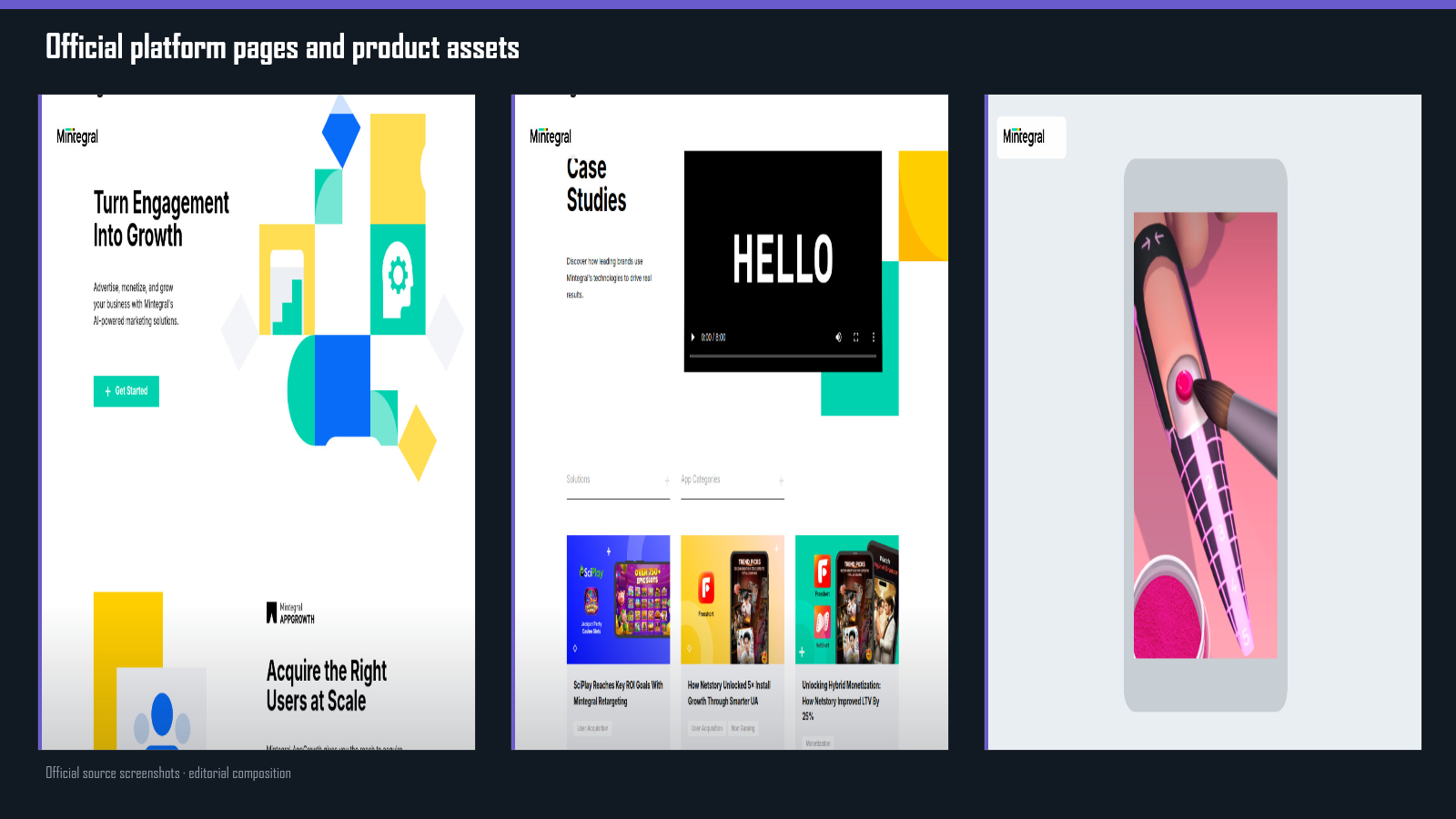
Mintegral's public product set covers AppGrowth, Retargeting, Monetization and the Mindworks creative studio. Together they move a product from buying an install to improving the user lifecycle.
AppGrowth
Acquisition focused on matching the right users, not just maximizing installs.
Retargeting
Brings existing users back for game events, releases, repeat purchases or content return visits.
Monetization
Combines placements, traffic and demand sources to raise total publisher revenue.
Mindworks / Playable
Interactive, playable and video creative reduce the time needed to understand a product. Creative is not only for clicks; it lowers comprehension cost.
Important: acquisition, retargeting and monetization are three data chains. If events and attribution are inconsistent, teams confuse “a channel brought users” with “users created revenue.”
Differentiation
Mintegral's most distinctive move is placing interactive creative near the center of growth. For games and complex tools, a static video cannot demonstrate the core loop; a playable lets users try it in seconds.
| Creative | User action | Best product | Key metrics |
|---|---|---|---|
| Video | Watch and understand | Games, content, utilities | Completion, click, install |
| Playable | Tap, try, convert | Casual and mid-core games | Demo completion, install, D1 |
| Native | Browse and click | Content, community, utilities | CTR, retention, eCPM |
| Rewarded video | Intentional exchange | Games and content | Completion, ARPDAU |
Do not leave interactive creative to the creative team alone. Script, load time, first interaction and reward feedback all affect conversion and retention.
Direct comparison with adjacent platforms
| Comparison | Where Mintegral is stronger | Where the other platform is stronger |
|---|---|---|
| Mintegral vs Pangle | More integrated acquisition, retargeting and monetization | Pangle has more direct TikTok for Business demand |
| Mintegral vs Meta | More vertical fit for games and interactive creative | Meta has larger global demand and broader category reach |
| Mintegral vs Moloco | A fuller playable and creative-production loop | Moloco has a deeper machine-learning and first-party-data story |
Decision rule: test Mintegral first for games or interactive products with strong creative iteration. Its advantage weakens when creative capacity is limited.
Fit map
| Product type | Fit | Recommended mix |
|---|---|---|
| Casual/mid-core games | High | AppGrowth + Playable + Monetization |
| Interactive content/community | Medium-high | Retargeting + native + rewarded |
| Utilities | Medium | AppGrowth test + native/low-frequency interstitial |
| Subscription apps | Medium-low | Retargeting first, monetization carefully |
| Commerce | Medium | Retargeting + native recommendations |
Best test subject: a product with a clear core action, a value proposition that can be demonstrated in ten seconds and repeat usage. That is where Mintegral's interactive growth advantage becomes measurable.
Integration
Mintegral integration usually involves its SDK, mediation or bidding and analytics. The real design is the loop between creative, events and bids:
- Define install, registration, key action and purchase events.
- Separate advertiser-side and publisher-side data purposes.
- Test playable and video creative at small volume.
- Observe how demand sources bid for the same traffic in mediation.
- Put D1/D7 retention, ROAS and ARPDAU on the same report.
Engineering note: playable file size, timeout and fallback affect the first interaction. Every interactive asset needs a static or video fallback.
Main advantage regions
★ 标记为该平台的主要优势区域。
| Market | Why it fits | What to watch |
|---|---|---|
| ★ Greater China and Southeast Asia | Dense game supply chains and fast creative testing | Language, payments and compliance vary by country |
| ★ Japan and Korea | High-value game users and mature in-app purchase markets | Strong localization, channel and support requirements |
| North America and Europe | Fit for mid-core games, retargeting and quality acquisition | Higher CPI; judge with LTV and ROAS |
| LATAM and the Middle East | Room for casual games and interactive ads | Monetization, payment and traffic quality differ |
| South Asia | Scale and low-cost creative testing | Lower ARPU requires separate monetization models |
Regional conclusion: Greater China, Southeast Asia, Japan and Korea are Mintegral's core game-growth zones; North America and Europe fit quality growth, while LATAM, MENA and South Asia fit incremental tests.
Economics
Mintegral should not be evaluated on CPI or eCPM alone. Put both sides on one line:
| Metric | Advertiser side | Publisher side |
|---|---|---|
| Cost | CPI / CPA / CPM | SDK and operations cost |
| Quality | D1/D7 retention, key action | Show and completion rates |
| Revenue | First purchase, subscription, ads | eCPM, ARPDAU |
| Outcome | ROAS / LTV | Net revenue per user |
Formula: LTV = ad revenue + in-app purchases + subscriptions - refunds and channel cost.
Strong acquisition ROI with weak monetization means the user-value loop is incomplete. High ad revenue with falling retention is borrowing from future value.
Risk boundaries
Three key risks:
- Creative fatigue: playable and video assets decay quickly without iteration;
- Attribution differences: advertiser, publisher and MMP dashboards may use different windows;
- Traffic quality: retargeting and interactive traffic need frequency control, exclusions and anti-fraud.
Execution rule: define an “effective user” before discussing price. Installs without retention and key actions are not real growth.
ze events and attribution.
Weeks 5–6: test AppGrowth at small volume and measure CPI, D1 and key actions.
Weeks 7–8: retarget or monetize quality users and calculate LTV.
Weeks 9–12: keep only markets and creative that pass ROAS, retention and net-revenue checks.
Free resource: the Mintegral Interactive Creative Test Sheet + ROAS/LTV Model. Scan the QR code or email info@hi-spark.com. HiSpark provides monetization integration, SDK/API delivery, app-store publishing and operations support.
Appendix: official developer documentation and SDK checklist
Official help center: https://www.mintegral.com/en/help-center
| Check | What must be confirmed before launch |
|---|---|
| Two-sided accounts | Advertiser and publisher accounts with matching app and placement setup |
| SDK initialization | Production/test environments, market parameters, consent and compatibility |
| Attribution | MMP partner, install events, key actions and channel parameters |
| Playable testing | First load, interaction completion, timeout fallback and crash recovery |
| Event callbacks | Standardized install, registration, purchase, retention and ad-revenue fields |
| Creative review | Video, playable, landing-page and vertical compliance |
| Store release | Privacy labels, tracking permission, SDK disclosure and review materials |
| Operations | ROAS, eCPM, ARPDAU, creative fatigue and traffic anomalies |
Documentation takeaway: launch acceptance must cover both acquisition and monetization events; otherwise the two sides cannot form one loop.
Official page: https://www.mintegral.com/cn