 Shenzhen HiSpark Ad Media Co., Ltd.

HiSpark · Overseas App Monetization Research · October 2026
The short answer: Meta Audience Network is not a separate advertising universe. Its role is to extend Meta advertiser demand into third-party app inventory.
This report does not begin with a platform encyclopedia. It answers three questions: where the platform sits in the growth stack, what makes it genuinely different, and when a team should not integrate it.


Market position
At a glance: strengths and trade-offs
| Dimension | Clear advantage | Real cost |
|---|---|---|
| Demand quality | Access to mature Meta advertiser budgets with global reach potential | Stricter account, traffic and content review; inventory varies by market |
| Creative fit | Native and video formats blend into content, utility and game contexts | Requires careful placement and frequency control; aggressive use hurts retention |
| Data capability | Teams can reuse event and creative knowledge from Meta acquisition | ATT/SKAN and consent are hard gates; full signal access must not be assumed |
Conclusion: Meta fits as a high-quality primary demand source, not as an unconditional fill fallback.
Meta Audience Network is not a separate advertising universe. Its role is to extend Meta advertiser demand into third-party app inventory.
| Question | Answer |
|---|---|
| What it provides | Demand and creative capability connected to Meta's advertising system |
| Best fit | Apps with global users, Meta acquisition experience and native/video ambitions |
| Poor fit | Apps without privacy foundations, stable traffic quality or realistic fill expectations |
| Core value | Mature advertiser demand, native/video formats and global reach potential |
| Main limit | Account review, privacy signals and market-by-market inventory differences |
Where the platform came from
| Time | Milestone | What it means today |
|---|---|---|
| 2014 | Meta launched Audience Network to extend demand into third-party apps | Established the “social demand + off-platform inventory” model |
| 2021 | Apple ATT changed iOS targeting and attribution | Privacy signals became the first gate for publishers |
| Post-2022 | Meta continued investing in automation and privacy technology | Audience Network behaves more like an extension of Meta than an independent network |
| 2026 | App inventory and privacy rules keep diverging by market | Validate every country, OS version and placement separately |
This explains the trade-off: demand is mature, but Meta will not redesign its privacy and advertising system for one publisher.
Business logic
Meta's advantage starts with advertiser density. Advertisers already use Meta for audience selection, creative testing and conversion optimization. Audience Network extends that demand to more app contexts.
There are two consequences:
- Publishers receive incremental demand. They do not need to sell every placement themselves.
- Advertisers gain more contexts. Demand can extend beyond social feeds into games, utilities, content and lightweight apps.
The publisher's side of the deal is equally important: high-quality, reviewable and measurable ad inventory. Long-term performance depends on traffic quality, user experience and privacy compliance, not integration alone.
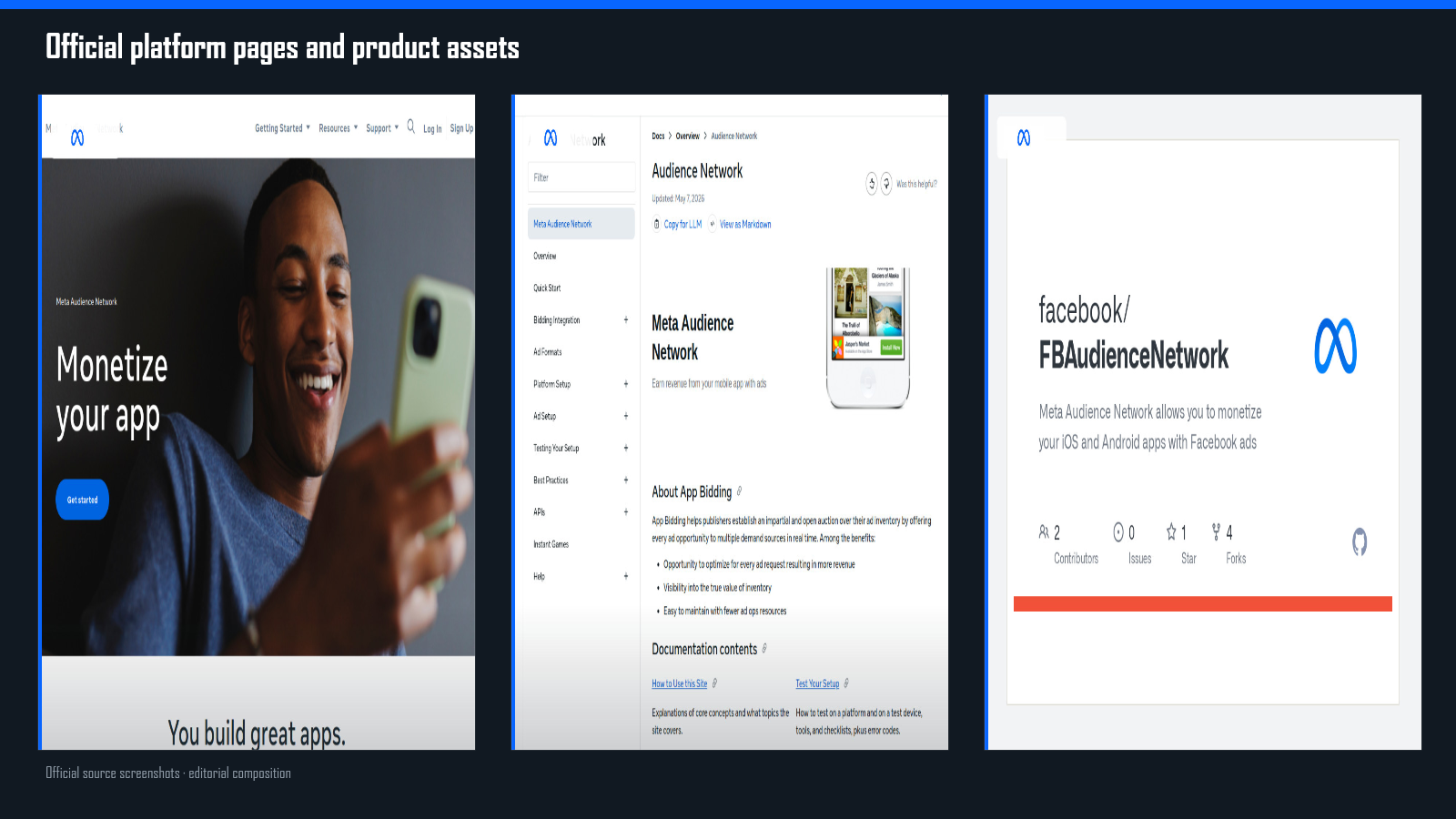
Product map
Meta Audience Network is commonly used in native, video and display-led contexts. Available formats, bidding paths and eligibility rules vary by policy and market; verify the current official documentation before integration.
| Placement | User intent | Fit | What to test |
|---|---|---|---|
| Native feed | User is browsing content | High | Visual consistency with surrounding content |
| Rewarded video | User intentionally exchanges time for a reward | High | Reward callback and completion |
| Interstitial | Transition or level end | Medium | Frequency control and next-day retention |
| Banner | Persistent footer or sidebar | Medium-low | Viewability and accidental clicks |
Start with native or rewarded placements. Aggressive formats may raise short-term revenue while transferring the cost to retention.
Differentiation
Advantage 1: demand from a mature advertiser market
Meta advertisers already optimize creative, audience and conversion events. For publishers, demand is connected to an operating advertising system rather than created from scratch.
Advantage 2: room for native and video expression
Utilities, content and casual games cannot rely on pop-ups alone. Meta's creative strength fits feed, video and interactive contexts when implemented carefully.
Advantage 3: reuse of creative and measurement knowledge
Teams already buying on Meta can carry creative learning and event discipline into monetization.
It is not a universal fallback. Unstable traffic, incomplete consent flows or a fill-only mindset will quickly hit review and signal constraints. The real advantage is the match between quality demand and quality context.
Direct comparison with adjacent platforms
| Comparison | Where Meta is stronger | Where the other platform is stronger |
|---|---|---|
| Meta vs Pangle | Global advertiser coverage and a mature buying system | Pangle is more concentrated in short-video creative and rewarded contexts |
| Meta vs Mintegral | Demand scale and cross-category reach | Mintegral is more integrated across acquisition, retargeting and interactive creative |
| Meta vs Moloco | Advertiser density and global brand demand | Moloco has a sharper first-party signal and ROAS-modelling story |
Decision rule: choose Meta for mature global demand, Mintegral for an interactive game loop and Pangle for rewarded/short-video incrementality.
Fit map
| App type | Why it fits | First test |
|---|---|---|
| Content, community, UGC | Long sessions and natural feed contexts | Native and video |
| Casual and mid-core games | Mature rewarded and video behavior | Rewarded video, between-level interstitial |
| Utilities and services | Frequent use and reward opportunities | Native, banner, rewarded |
| Commerce and transaction apps | Strong intent but low ad tolerance | Native recommendations, low-frequency interstitial |
| Subscription apps | Ads may reduce willingness to pay | Strict frequency and user segmentation |
Do not launch blindly. If placement design, consent flows and retention baselines are missing, fix the foundation before testing Meta.
Main advantage regions
★ 标记为该平台的主要优势区域。
| Market | Why it fits | What to watch |
|---|---|---|
| ★ North America | The most mature Meta demand and highest budget density | Strict ATT, privacy and traffic review |
| ★ UK and Western Europe | Strong brand, commerce and performance budgets | GDPR consent, ad quality and local creative |
| Australia/NZ, Japan and Korea | High-value users and mature mobile advertising | Competitive pricing and local-language optimization |
| Southeast Asia and LATAM | Scale and incremental advertiser demand | Lower eCPM and tighter acquisition economics |
| Middle East | High mobile engagement and a young audience | Content review, payments and cultural fit |
Regional conclusion: North America, the UK, Western Europe and mature APAC are Meta's core advantage zones; Southeast Asia and LATAM are better for scale and incremental tests.
Integration
Meta Audience Network is typically integrated through its ad SDK and a mediation or bidding layer. The hard part is not rendering an ad, but stabilizing initialization, consent, requests and event callbacks.
Recommended sequence:
- Define placements and user segments.
- Complete consent and SDK initialization mapping.
- Integrate through a mediation layer and observe Meta in the overall auction.
- Standardize impression, click, revenue and user-event naming.
- Run an A/B test covering eCPM, show rate, retention and total revenue.
Engineering checks: Does cold start get longer? Do request timeouts affect the main flow? Does an ad failure degrade gracefully? These details matter more than adding one more network.
Economics
Track at least five metrics after integration:
| Metric | Meaning | Warning sign |
|---|---|---|
| Fill rate | Share of requests receiving an ad | Drops can reflect market, policy or traffic quality |
| Show rate | Share of returned ads actually shown | Low values suggest lifecycle or visibility issues |
| eCPM | Revenue per thousand impressions | A rise may hide a change in traffic mix |
| ARPDAU | Daily ad revenue per active user | Closer to actual business outcome |
| Retention | D1 and D7 retention | Usually the first metric to deteriorate under excessive frequency |
Use total revenue, ARPDAU, retention and LTV as primary metrics. Treat eCPM as an explanatory variable, not the goal.
Risk boundaries
Risk comes from four directions:
- Account and traffic review: content, sources and placements must comply with platform rules;
- Privacy and consent: ATT, regional privacy laws and SDK data use must be explainable;
- Ad quality: creative, landing pages and accidental clicks affect users and platform standing;
- Attribution differences: dashboards, MMPs and finance may use different windows.
Most important: do not assume unrestricted access to Meta audience data. Use the approved interfaces, communicate data purposes and maintain deletion, opt-out and retention controls.
zation integration, SDK/API delivery, app-store publishing and ongoing operations.
Appendix: official developer documentation and SDK checklist
Official developer entry: https://developers.facebook.com/docs/audience-network/
| Check | What must be confirmed before launch |
|---|---|
| Account and eligibility | Developer account, app review, supported markets and placement approval |
| Initialization order | Initialize only after consent management is complete |
| Placements | Keep test and production placement IDs separate |
| Test mode | Validate load, impression, click, close and error callbacks with test ads |
| Events and revenue | Send impressions, clicks, revenue and user events into one reconciliation layer |
| iOS requirements | ATT prompt, privacy manifest, SKAN and target-version compatibility |
| Mediation and bidding | Define bidding or mediation path, timeout and fallback |
| Production monitoring | Track fill, timeout, crashes, show rate and release regressions |
Documentation takeaway: account, privacy, testing and revenue events must all pass together. An SDK install alone is not integration.
Official page: https://www.facebook.com/audiencenetwork