 Shenzhen HiSpark Ad Media Co., Ltd.

HiSpark · Overseas App Monetization Research · October 2026
The short answer: Adjust is a mobile measurement partner, not an ad network. It does not sell inventory and does not replace demand from Meta, Pangle, Mintegral, Moloco or Yandex.
This report does not begin with a platform encyclopedia. It answers three questions: where the platform sits in the growth stack, what makes it genuinely different, and when a team should not integrate it.


Positioning
At a glance: strengths and trade-offs
| Dimension | Clear advantage | Real cost |
|---|---|---|
| Cross-channel measurement | Compares ad platforms under one event and window model | Attribution differences are normal and require ongoing reconciliation |
| SKAN and callbacks | Organizes signals, events and partner callbacks in the privacy era | Event design, delay monitoring and consent are all essential |
| Fraud control | Detects abnormal installs, clicks and events | An MMP does not create revenue and cannot fix a weak product |
Conclusion: Adjust fits multi-channel teams that need explainable data; it is not a sixth ad network.
Adjust is a mobile measurement partner, not an ad network. It does not sell inventory and does not replace demand from Meta, Pangle, Mintegral, Moloco or Yandex.
| Dimension | What Adjust handles |
|---|---|
| Attribution | Installs, clicks, impressions and channel source |
| Events | Registration, key actions, purchases and retention |
| Deep links | Routing users to the right page or campaign |
| SKAN | Conversion measurement in the iOS privacy era |
| Callbacks | Server events and partner callbacks |
| Fraud prevention | Detection of suspicious installs, clicks and events |
In one line: ad platforms deliver the ad; Adjust determines whether the ad created measurable value.
Where the platform came from
Adjust was founded in Berlin in 2012 and focused on mobile attribution and measurement. In 2021 it was acquired by AppLovin and became part of a broader software and commercialization portfolio. That matters: its ownership sits inside adtech, while its product role remains independent measurement.
| Time | Milestone |
|---|---|
| 2012 | Founded in Berlin and entered mobile attribution |
| Attribution maturity | Deep links, events, partner setup and fraud prevention became core capabilities |
| 2021 | Acquired by AppLovin and joined a larger adtech group |
| iOS privacy era | SKAN, modelling and server callbacks became essential infrastructure |
This creates a tension: Adjust must preserve measurement credibility while belonging to an adtech company. For customers, the value is transparent definitions, not a prettier dashboard number.
Attribution flow
A mobile install goes through several steps before it is counted:
- A user sees an ad or clicks a link;
- The channel sends click data to the measurement layer;
- The user opens the app and completes installation;
- The MMP matches channel, click time, device signals and rules;
- Attribution is sent to the network, BI and finance systems;
- Product teams use events and retention to judge channel quality.
The hard part is reconciliation: the network, MMP, payment system and BI may use different time zones, windows, deduplication rules and revenue definitions.
Mature teams do not ask “which number is true?” They ask “why do the numbers differ, and can the difference be explained?”
Product map
| Capability | Problem solved | Main teams |
|---|---|---|
| Install and event attribution | Where users came from and what they did | Growth, product, media |
| Deep links | Sending users to the right page after an ad | Product, operations, engineering |
| SKAN workflows | Conversion measurement after signal loss | Growth, data, legal |
| Server callbacks | Reliable delivery of key events to partners | Backend and data |
| Reporting and alerts | Channel, creative and user-value analysis | Growth, BI, finance |
| Fraud prevention | Detecting abnormal installs and events | Risk and media |
It is not a single SDK story. The real value comes from event design, partner configuration, callback governance and shared definitions.
Differentiation
1Cross-channel comparability
Each network optimizes its own dashboard, but an MMP can compare channels under one event and window model.
2Independent decisions
Attribution data does not belong to a single ad platform. It is better suited to deciding whether budget should continue, stop or move.
3Fraud prevention and governance
Standardized events, callbacks and anomaly detection reduce duplicate attribution, fake installs and channel arbitrage.
Boundary: Adjust is not a revenue multiplier. It cannot fix weak retention or turn low-quality traffic into high-value users.
Direct comparison with adjacent platforms
| Comparison | Where Adjust is stronger | Where the other platform is stronger |
|---|---|---|
| Adjust vs Meta/Pangle | Independent cross-channel comparison under unified event definitions | Ad platforms directly control demand, bidding and placements |
| Adjust vs Moloco | A more neutral view across multiple channels | Moloco executes acquisition and model optimization directly |
| Adjust vs a single network dashboard | More complete SKAN, deep-link, callback and fraud workflows | A network dashboard is closer to that platform's immediate campaign operations |
Decision rule: Adjust becomes infrastructure as channels and budget complexity grow. With one demand source, it cannot replace the platform's own execution capabilities.
Fit map
| Stage | Need for MMP | Focus |
|---|---|---|
| New app, one channel | Conditional | Validate a minimal event set |
| Multi-channel acquisition | Strong | Cross-channel attribution and fraud prevention |
| Global iOS product | Strong | SKAN, callbacks and modelling interpretation |
| Hybrid IAA and IAP | Strong | Unify ad and purchase revenue |
| Organic-only product | Low to medium | Product analytics matters more than channel attribution |
Decision rule: when channels, events and budget exceed manual reconciliation, an MMP moves from optional tooling to infrastructure.
Main advantage regions
★ 标记为该平台的主要优势区域。
Note: Adjust does not sell ad inventory. These regions reflect where its attribution, SKAN and cross-channel measurement fit is strongest.
| Market | Why it fits | What to watch |
|---|---|---|
| ★ North America | Mature iOS privacy, SKAN and multi-channel attribution needs | Align MMP, payments, BI and network definitions |
| ★ Europe | Strong need for privacy-compliant measurement and callbacks | Consent, retention and cross-border transfer |
| ★ Japan and South Korea | High-value apps, games and mature multi-channel growth | Local partners, events and support |
| Southeast Asia and LATAM | Fast multi-channel expansion needs a common attribution layer | Device, network, payment and traffic quality vary |
| Middle East | Fast mobile growth and localized-channel measurement | Local compliance, payments and language |
Regional conclusion: Adjust best fits North America, Europe and mature APAC markets, especially iOS-heavy products with multiple channels. In emerging markets, use it to standardize traffic quality and definitions.
Integration
A typical Adjust rollout:
- Define the event dictionary and conversion values;
- Configure channel partners and callbacks;
- Implement SDK, deep links and consent;
- Establish SKAN and server-callback workflows;
- Reconcile with BI, payments and ad platforms;
- Alert on anomalies, delays and duplicate callbacks.
Most common failure: many event names, none useful for operating decisions. Before recording 100 events, define install, registration, key action, purchase and retention clearly.
Economics
Adjust does not create ad revenue directly, but it determines how budget moves:
| Metric | Budget impact |
|---|---|
| D1/D7 retention | Whether the channel brings effective users |
| Key-action rate | Whether installs are empty shells |
| LTV/CAC | Whether scale is repeatable |
| Incrementality | Whether budget creates genuine lift |
| Refunds and bad debt | Corrects superficially attractive ROAS |
Critical note: attribution is not a financial statement. Reconcile it with payments, refunds, subscriptions and ad revenue before making operating decisions.
Risk boundaries
The most common MMP risks:
- Platform discrepancies: network, MMP and BI numbers differ by design;
- Consent: signals from non-consented users should not be used without limits;
- Retention: how long events are kept, who can access them and how they are deleted;
- Attribution bias: last-click can understate brand and organic demand;
- Overreliance: treating attribution as the only truth instead of a set of explainable measurements.
Advice: maintain separate decision and finance-reconciliation dashboards rather than forcing one report to answer every question.
zation integration, MMP/API delivery, app-store publishing and event-data design.
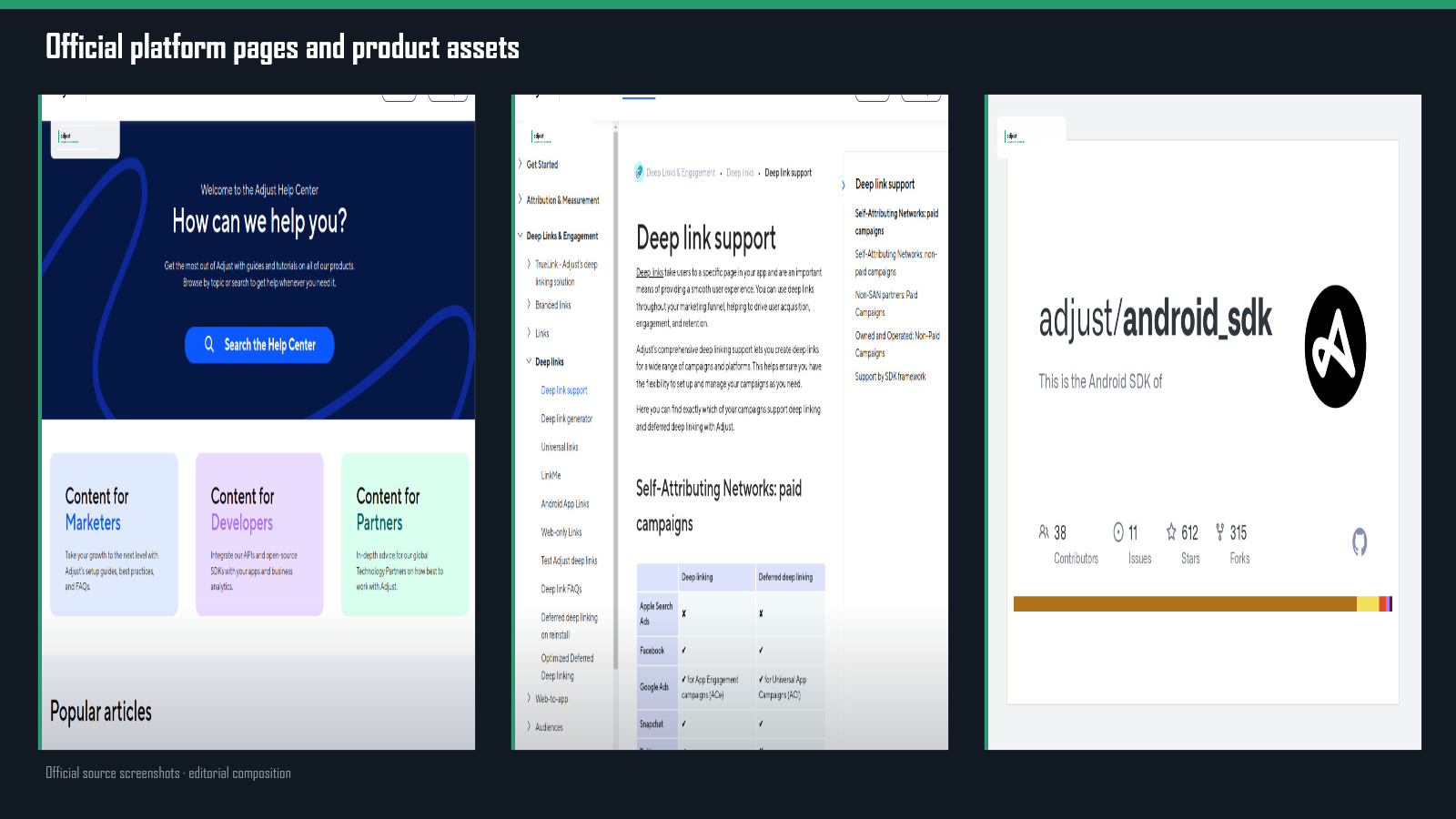
Appendix: official developer documentation and SDK checklist
Official help center: https://help.adjust.com/
Deep-link documentation: https://help.adjust.com/en/article/deep-link-support
| Check | What must be confirmed before launch |
|---|---|
| App token | Strict separation between test and production SDK environments |
| Event dictionary | Unified install, registration, key action, purchase, refund and retention names |
| Deep links | Universal Links, App Links, deferred deep links and fallback |
| Callbacks | Server events, partner callbacks, retries, deduplication and delay monitoring |
| SKAN | Conversion values, windows, privacy thresholds and modelled-data interpretation |
| Fraud prevention | Monitoring for abnormal installs, clicks, events and channel arbitrage |
| Privacy | Consent records, purpose, retention and deletion processes |
| Reconciliation | Align MMP, network, BI, payment and finance definitions |
Documentation takeaway: the acceptance test is not “an install appeared.” Every key event must be explainable, replayable and reconcilable.
Official page: https://www.adjust.com/