





Quick decision: who should look closer, and who should wait
| Best fit | Required foundation | Avoid when |
|---|---|---|
| CTV, open internet and cross-channel brands | First-party data, measurement partners and supply-path checks | Small budgets or no programmatic team |
| Brand and performance working together | Holdouts, frequency control and cross-channel review | A single-platform immediate ROAS target |
| Mature brands, agencies and enterprise teams | Clear UID2, data permission and brand-safety workflows | Opaque supply that cannot be verified |
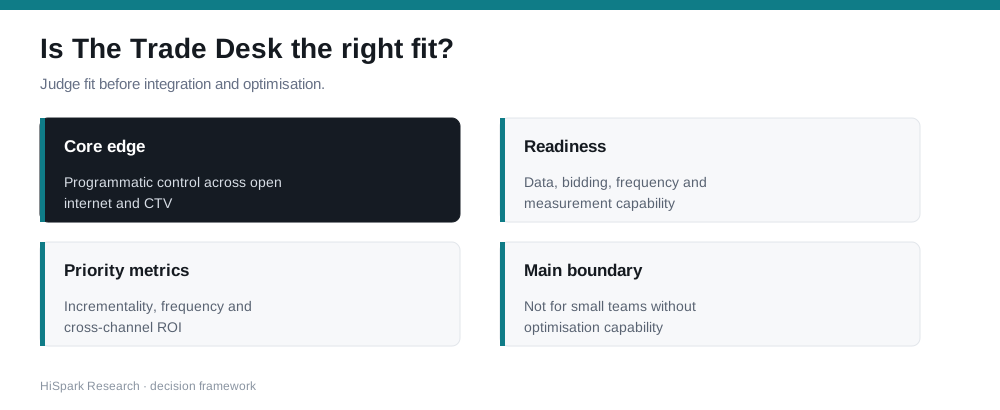
Check whether the business has the required foundation before discussing account setup, assets, data and budget. Specific decisions depend on category, account and market context.
Shenzhen HiSpark Ad Media Co., Ltd. supports Bidding, Waterfall and hybrid strategies, with multi-platform A/B testing, traffic bucketing, floor-price configuration and revenue reviews. The goal is to save implementation time, avoid integration pitfalls and improve test efficiency.
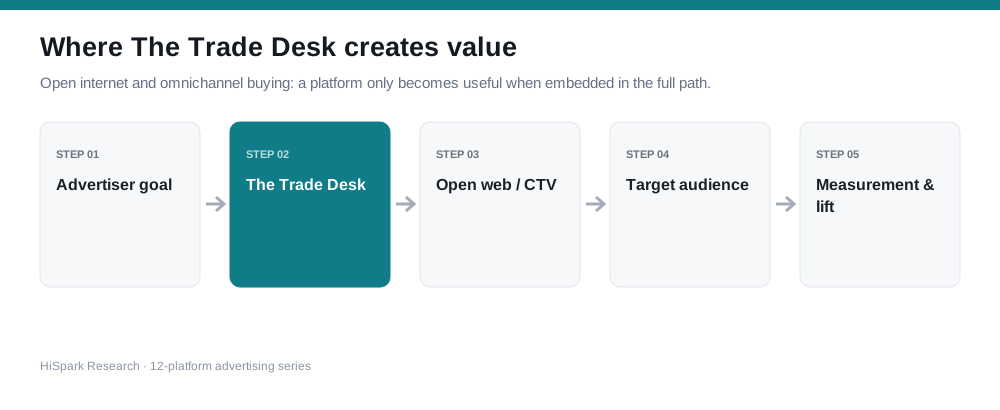
The Trade Desk is often placed in the same table as Meta, AppLovin or Pangle because all of them can buy advertising. The roles are different. Those platforms own or organize specific inventory. The Trade Desk is a demand-side platform that represents the advertiser across open-internet inventory, data, targeting and measurement choices.
The company emphasizes three principles: it does not own or operate media, it connects an open marketplace of data and measurement partners, and it provides transparent campaign controls. Those principles explain both its advantages and its operating threshold.

01. What a DSP actually solves
A DSP connects budget, audience, bid, frequency, inventory and data, then runs real-time auctions and optimization across media environments. The Trade Desk covers CTV and OTT, video, display, audio, native, mobile and digital out-of-home.
It does not replace an MMP. Attribution may still be handled by Adjust, AppsFlyer, an independent measurement partner, MMM or the advertiser's own data. The Trade Desk provides exposure data, conversion onboarding, measurement integrations and cross-channel reporting. The right architecture is: the DSP buys and optimizes; measurement partners validate the outcome.
The value of a DSP is not that it can access a lot of inventory. It is the ability to decide which inventory deserves budget under one data and frequency framework.
02. Business model: where the money and strategic control sit
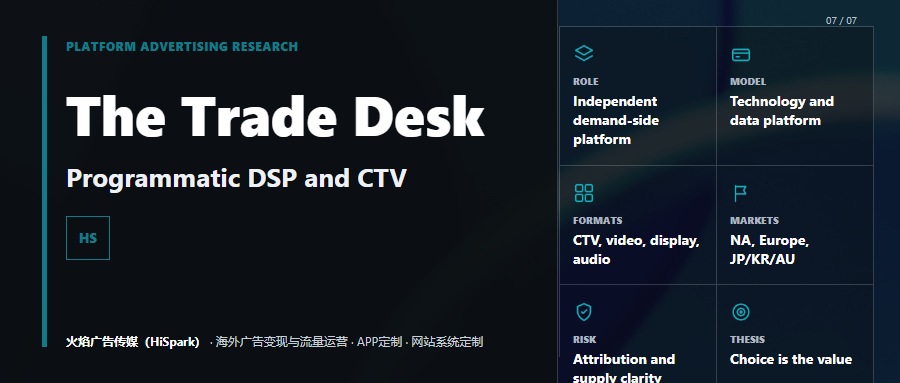
The Trade Desk is a demand-side platform. It does not own media; it connects budget, audience data, bidding, frequency and measurement partners. Its value is cross-channel choice and transparency. Its threshold is operational maturity across data, supply paths and experimentation. It does not replace an MMP or CRM, and it cannot manufacture incrementality by itself.
03. Core capabilities and channels
| Capability | What it solves | Operating prerequisite |
|---|---|---|
| Omnichannel | Buy CTV, video, audio, display and more under one strategy | Unified goals, frequency and de-duplication rules |
| UID2 / Identity | Connect audiences as third-party cookies decline | Identity, privacy and data partnerships |
| Measurement | Connect exposure, conversion, retail and brand-lift data | Measurement partner, test design and access |
| OpenPath | Explore more direct connections to quality inventory | Verify supply path, price and transparency |
| Data Marketplace | Access third-party and retail data | Data quality, permission and usage boundaries |
| CTV / OTT | Reach streaming households across screens | Content environment, frequency and cross-device measurement |

04. Priority markets
The Trade Desk is most suitable where programmatic infrastructure is mature. Validate the United States, Canada, the United Kingdom, Germany, France, Japan, South Korea and Australia first. CTV, open-internet inventory, data partners and measurement services are more developed in these markets. Latin America, the Middle East and Southeast Asia require separate assessment of supply, agency relationships and privacy rules.
05. The Trade Desk, DV360 and Amazon DSP
| Platform | Relative position | Better fit |
|---|---|---|
| The Trade Desk | Independent DSP emphasizing the open internet, objective inventory selection and an open measurement ecosystem | Mature teams with cross-channel strategy, data and agency resources |
| Google DV360 | Programmatic platform tightly connected to Google's ad and data ecosystem | Teams that rely on Google, YouTube and DV360 workflows |
| Amazon DSP | Connected closely to Amazon retail, shopping signals and media | Businesses where Amazon conversion and shopping data are central |
This is not a ranking. The difference is the buying environment and data sources. The Trade Desk's independence can support more neutral inventory selection across media. If a business depends heavily on shopping signals inside a closed ecosystem, another DSP may be more direct.

06. A DSP is not an incrementality button
Without clear objectives, conversion definitions, data permissions and experimental design, a DSP will spend more budget with more complexity. Common risks include treating platform attribution as true incrementality, opaque supply paths, broken cross-channel frequency, duplicate reach mistaken for new reach, incomplete privacy review, and small budgets consumed by fixed operating costs. Clarify data, supply, measurement, contracts and operating ownership before launch.
07. Summary
- The Trade Desk is a DSP, not an ad network and not an MMP.
- Its advantage is choice across the open internet and CTV, not ownership of traffic.
- North America, Europe and selected Asia-Pacific markets are the clearest first lens.
- Supply transparency, identity and measurement design determine whether the DSP creates real value.