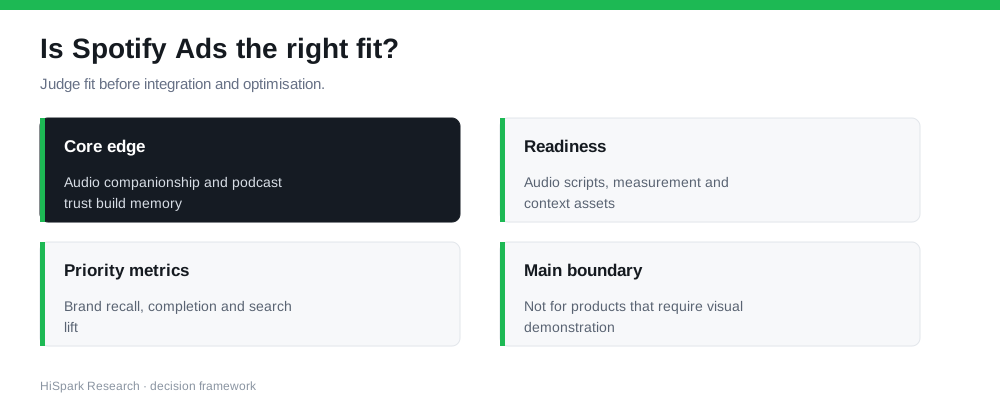






Quick decision: who should look closer, and who should wait
| Best fit | Required foundation | Avoid when |
|---|---|---|
| Consumer goods, automotive, finance, technology, travel | Audio scripts, branded search and cross-channel measurement | Same-day click ROI as the only target |
| Brands building long-term memory | Audio, video and podcasts can work as a set | No audio production or review capability |
| Music and podcast audiences fit the product | Brand lift and assisted conversion are accepted | Unsupported efficacy claims |
Check whether the business has the required foundation before discussing account setup, assets, data and budget. Specific decisions depend on category, account and market context.
Shenzhen HiSpark Ad Media Co., Ltd. supports Bidding, Waterfall and hybrid strategies, with multi-platform A/B testing, traffic bucketing, floor-price configuration and revenue reviews. The goal is to save implementation time, avoid integration pitfalls and improve test efficiency.
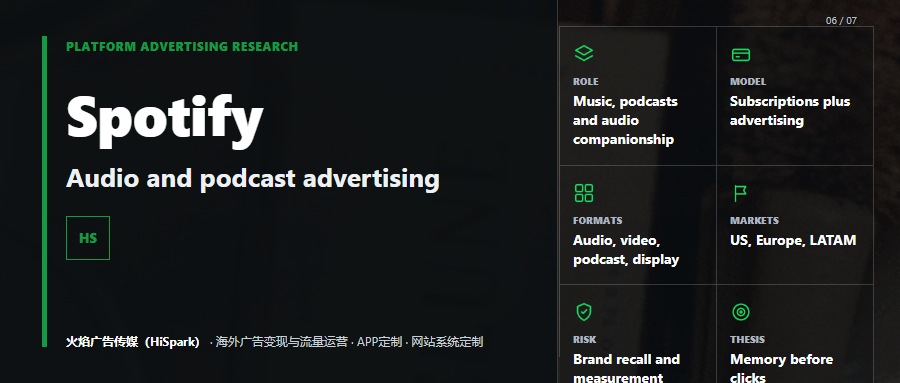
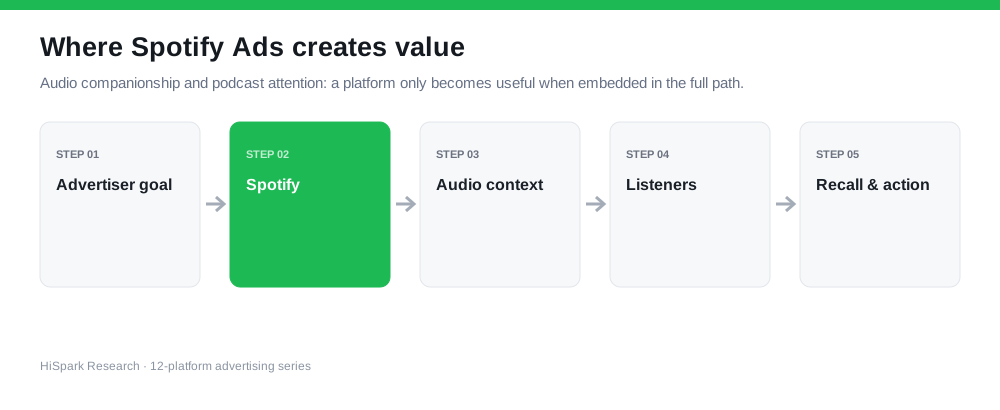
Audio advertising is easy to underestimate because users do not click the screen. That is also the advantage. During commuting, exercise, housework, focused work and bedtime, a brand can remain present in a screenless moment. Spotify extends this companionship across music, podcasts, video podcasts and visual player interfaces.
The official homepage cites more than 777 million monthly active users. Spotify also argues that audio and video or display work better together than audio alone. The right evaluation is not only clicks; it is whether the campaign improves memory, branded search, direct traffic and later conversion.

01. Four layers of attention
- Screenless companionship: audio between songs and podcasts builds familiarity and emotional association.
- In-screen attention: video and display appear when users actively look at the player interface.
- Host trust: podcast advertising borrows the long-term relationship between host and listener.
- Action: CTA, companion image, carousel and landing page convert memory into a visit, signup or purchase.
The first KPI for audio is often not a click. It is whether people remember the brand and come back later.
02. Business model: where the money and strategic control sit
Spotify combines subscriptions and advertising. Free users create ad inventory, paid users create subscription revenue, and podcasts and video add new content contexts. The scarce asset for advertisers is sound-first attention away from the screen, together with the long-term trust between podcast hosts and listeners.
03. Format mix and creative requirements
| Format | Best task | Creative principle |
|---|---|---|
| Audio Ads | Awareness, consideration and retargeting | Name the brand and value within the first three seconds |
| Video Ads | Demonstration, launch and conversion | Sound and visuals must each make sense |
| Podcast Ads | Explanation and host endorsement | Sound like the show, not a television spot |
| Display Ads | Visual reinforcement and traffic | Legible brand and CTA at small size |
| Carousel Ads | Multiple products or steps | One idea per card |
Spotify's podcast page reports that more than 390 million users have streamed a video podcast and that 59% of Spotify podcast fans feel more connected to hosts than to social-media influencers. That trust cannot be replaced by a generic display asset. It calls for custom host reads, thematic sponsorship and longer series commitments.
04. Priority markets
Validate the United States, United Kingdom, Germany, France, Canada, Australia, Brazil and Mexico first. North America and Europe have mature music, podcast and brand-advertising ecosystems. Latin America has strong mobile and music engagement, but language, payment and inventory need separate review. Access can vary across Spotify Ads Manager, Direct IO and Spotify Ad Exchange, so confirm current local availability before planning.
05. Spotify versus Meta, YouTube and traditional radio
| Channel | Core context | Relative advantage | Main limit |
|---|---|---|---|
| Spotify | Music, podcasts and screenless companionship | Sound-first attention, host trust and cross-screen formats | Fewer clicks; longer evaluation window |
| Meta | Social feed and short video | Granular targeting, interaction and conversion tracking | Creative fatigue and ad avoidance |
| YouTube | Video search and viewing | Visual storytelling, depth and search capture | Production cost and competition |
| Traditional radio | Broad local companionship | Mass reach and local memory | Limited targeting and attribution |

06. Audio-specific risks
The ad fails when the brand is hard to recognize, the name appears too late, music covers the voice, or the CTA only works on screen. Podcast host reads require script approval and clear boundaries around host opinions. Healthcare, finance, alcohol, gambling and children's categories need policy and local-law review. Do not use a host voice to make unsubstantiated efficacy claims.
07. Summary
- Spotify's core asset is companionship through sound, not a visual feed.
- Audio, video, podcasts and display work as a system; click-only measurement misreads the value.
- North America, Europe and Latin America are the main market lenses, with buying access varying by country.
- Brand memory, search lift and assisted conversion describe audio value better than last-click alone.