

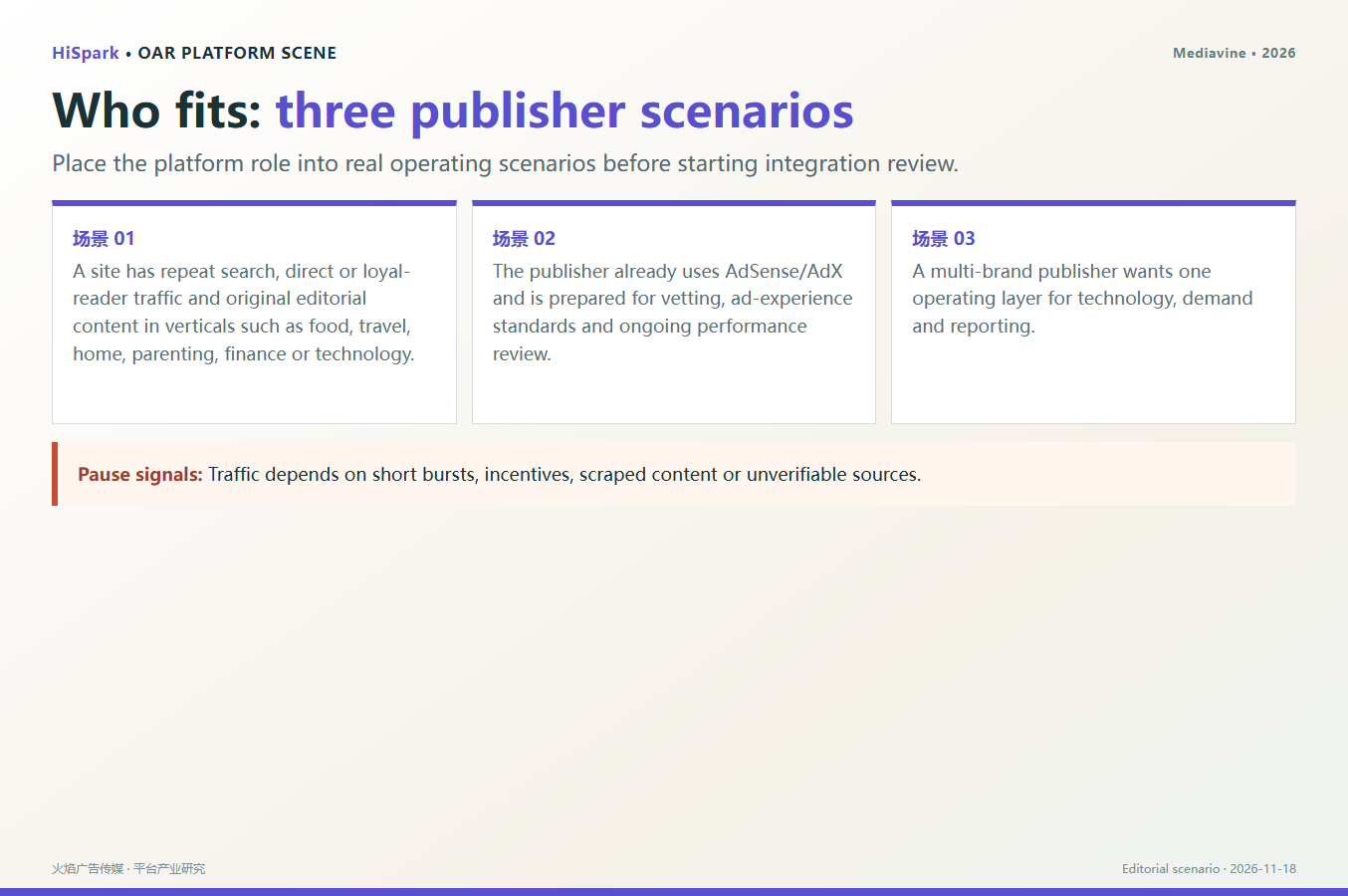
A site has repeat search, direct or loyal-reader traffic and original editorial content in verticals such as food, travel, home, parenting, finance or technology.

Mediavine
Publisher network & managed monetisation · Publisher-side revenue operations
1. Platform role and category
Mediavine sits between publishers and advertiser demand, combining ad management, demand access, publisher vetting, placement strategy, technical maintenance and ongoing optimisation.
The official site separates full Mediavine from Journey by Mediavine: the former targets sites with an existing revenue base, while the latter supports growing publishers.
It is neither an open-registration SSP nor a traffic-only network. Content quality, traffic source, AdSense/AdX standing and reader experience are part of the access decision.
2. Business model and commercial terms
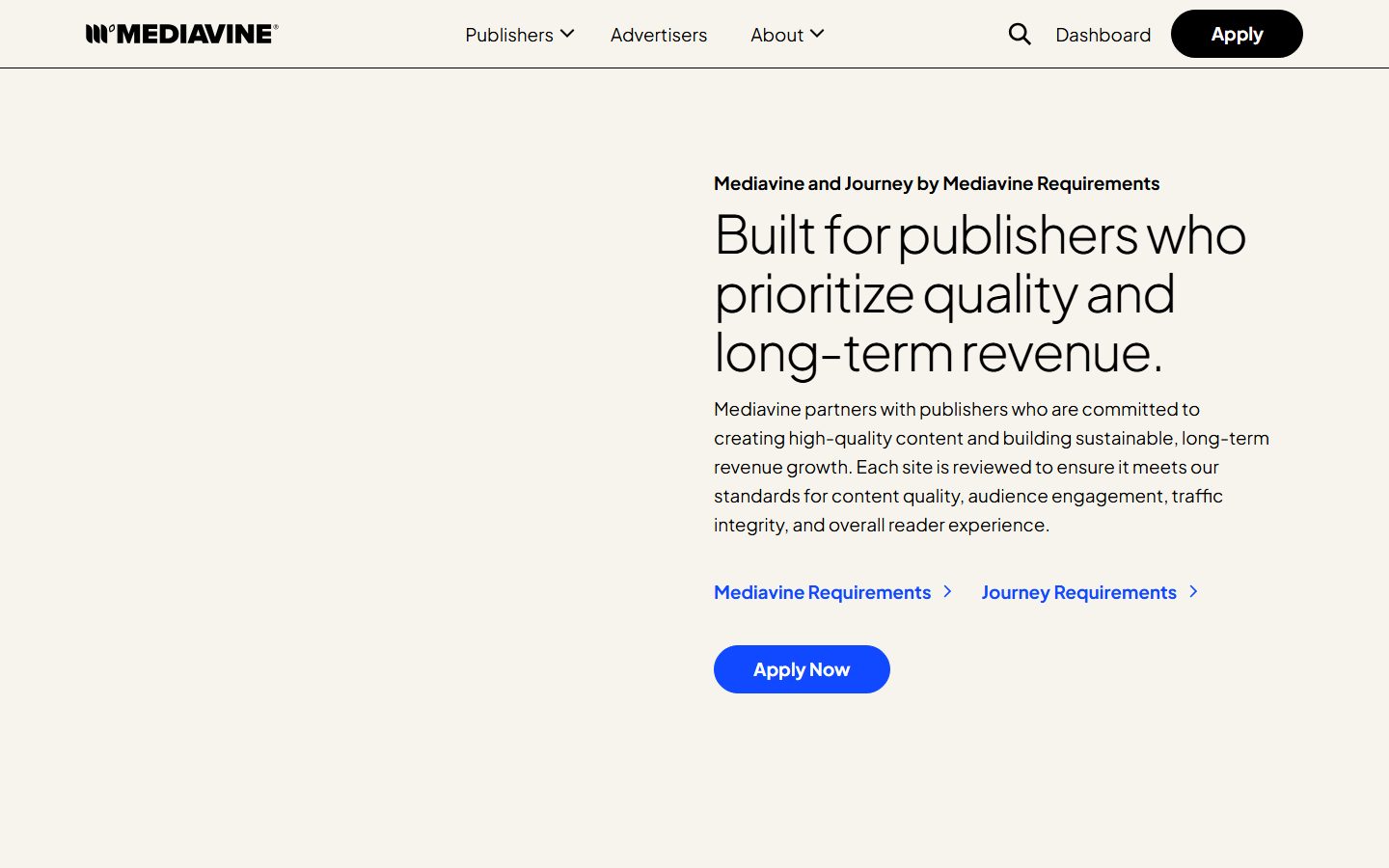
The published full Mediavine criteria include at least USD 5,000 in annual ad revenue, original audience-first content, clean human brand-safe traffic, good standing with AdSense and AdExchange, and a reader experience that supports premium advertising.
Journey by Mediavine serves sites below the full threshold: the official page requires at least 5,000 monthly sessions from the US, UK, Canada, Australia, Germany, France or the Netherlands, a domain at least four months old, and continued content and traffic-quality review.
No uniform revenue-share rate is published. A real agreement must be checked for revenue share, payment cycle, ad-code ownership, data access, exit terms and treatment of the publisher’s existing AdSense/AdX setup.
3. Where value comes from
Value levers
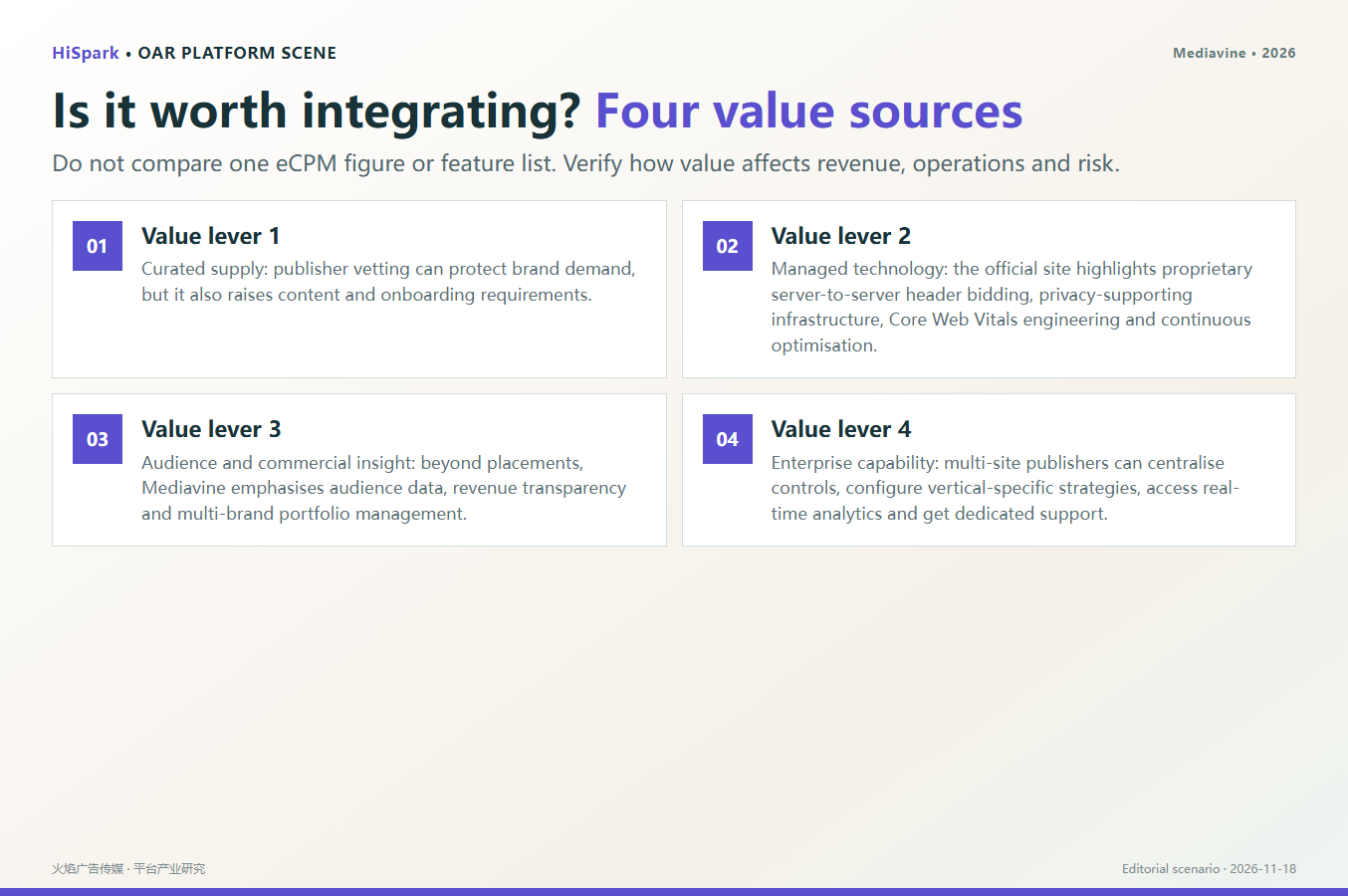
- Curated supply: publisher vetting can protect brand demand, but it also raises content and onboarding requirements.
- Managed technology: the official site highlights proprietary server-to-server header bidding, privacy-supporting infrastructure, Core Web Vitals engineering and continuous optimisation.
Operating value
- Audience and commercial insight: beyond placements, Mediavine emphasises audience data, revenue transparency and multi-brand portfolio management.
- Enterprise capability: multi-site publishers can centralise controls, configure vertical-specific strategies, access real-time analytics and get dedicated support.
4. Who fits, and who should wait
A good fit when
- A site has repeat search, direct or loyal-reader traffic and original editorial content in verticals such as food, travel, home, parenting, finance or technology.
- The publisher already uses AdSense/AdX and is prepared for vetting, ad-experience standards and ongoing performance review.
- A multi-brand publisher wants one operating layer for technology, demand and reporting.
Do not rush when
- Traffic depends on short bursts, incentives, scraped content or unverifiable sources.
- The site is below the revenue or Journey traffic thresholds and treats platform access as a substitute for growth.
- The team will not address ad density, page speed, consent management or reader experience.
- The publisher needs instant self-service onboarding and a public standard price list.
5. A controlled integration path
- Check annual ad revenue, Journey-eligible monthly sessions by country, domain age, originality and traffic sources against the official criteria.
- Prepare 90-day evidence for AdSense/AdX standing, leading markets, device mix, page speed, CMP and privacy disclosures.
- Use a test page or limited traffic split to measure ad density, CLS, LCP, viewability and content-completion impact.
- Put revenue share, payment, data export, code ownership, exit and migration rights into the commercial comparison.
- After launch, review monetised sessions, RPM, speed, engagement and organic search together instead of judging short-term revenue alone.
6. AdSense, SSP and publisher optimisation are different roles
| Role | Category | What it primarily sells |
|---|---|---|
| Mediavine | Publisher network & managed monetisation | Curated access, demand, technology and managed ad ops |
| AdSense | Publisher ad network | Base demand access, implementation and reporting |
| SSP | Sell-side platform | Inventory packaging, demand connection and transaction execution |
| Ezoic | Publisher monetisation optimisation | Testing, mediation and site-growth tools |
A publisher can use multiple layers together. The decision is not which logo replaces another, but who controls demand, inventory, testing, data, compliance and operations.
7. Typical customer scenarios
Put the platform back into a real publisher or advertiser workflow. The same feature set can be valuable for one team and premature for another.
The publisher already uses AdSense/AdX and is prepared for vetting, ad-experience standards and ongoing performance review.
A multi-brand publisher wants one operating layer for technology, demand and reporting.
Pause signals
- Traffic depends on short bursts, incentives, scraped content or unverifiable sources.
- The site is below the revenue or Journey traffic thresholds and treats platform access as a substitute for growth.
- The team will not address ad density, page speed, consent management or reader experience.
- The publisher needs instant self-service onboarding and a public standard price list.
8. How to judge whether the value is real
Do not reduce the decision to one headline metric. Value must be visible in revenue quality, operating hours, risk control and the ability to explain results to management.
| Value source | What to verify | Evidence |
|---|---|---|
| Curated supply: publisher vetting can protect brand demand, but it also raises content and onboarding requirements. | Validate with live data, not a feature list. | Dashboard, contract, test page or implementation record. |
| Managed technology: the official site highlights proprietary server-to-server header bidding, privacy-supporting infrastructure, Core Web Vitals engineering and continuous optimisation. | Validate with live data, not a feature list. | Dashboard, contract, test page or implementation record. |
| Audience and commercial insight: beyond placements, Mediavine emphasises audience data, revenue transparency and multi-brand portfolio management. | Validate with live data, not a feature list. | Dashboard, contract, test page or implementation record. |
| Enterprise capability: multi-site publishers can centralise controls, configure vertical-specific strategies, access real-time analytics and get dedicated support. | Validate with live data, not a feature list. | Dashboard, contract, test page or implementation record. |
Official product, documentation and case evidence
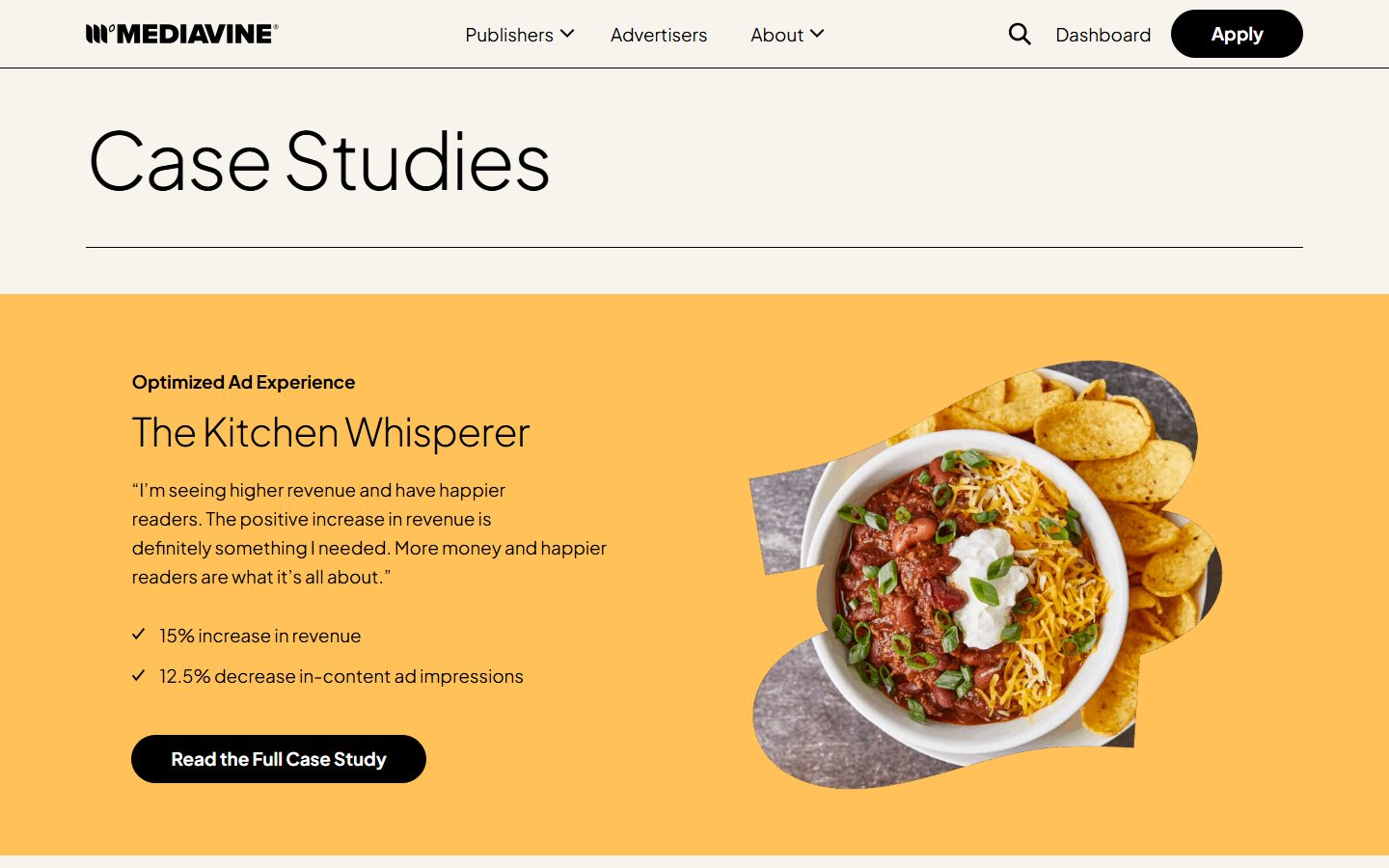
These screenshots come from official product, documentation, eligibility or case-study pages captured on 18 Nov 2026. They are included as visual evidence for the platform’s current public proposition, not as a guarantee of commercial terms.

9. Pre-integration evidence checklist
A platform introduction is not an integration recommendation. The following items should have an owner, a current artefact and a decision date.
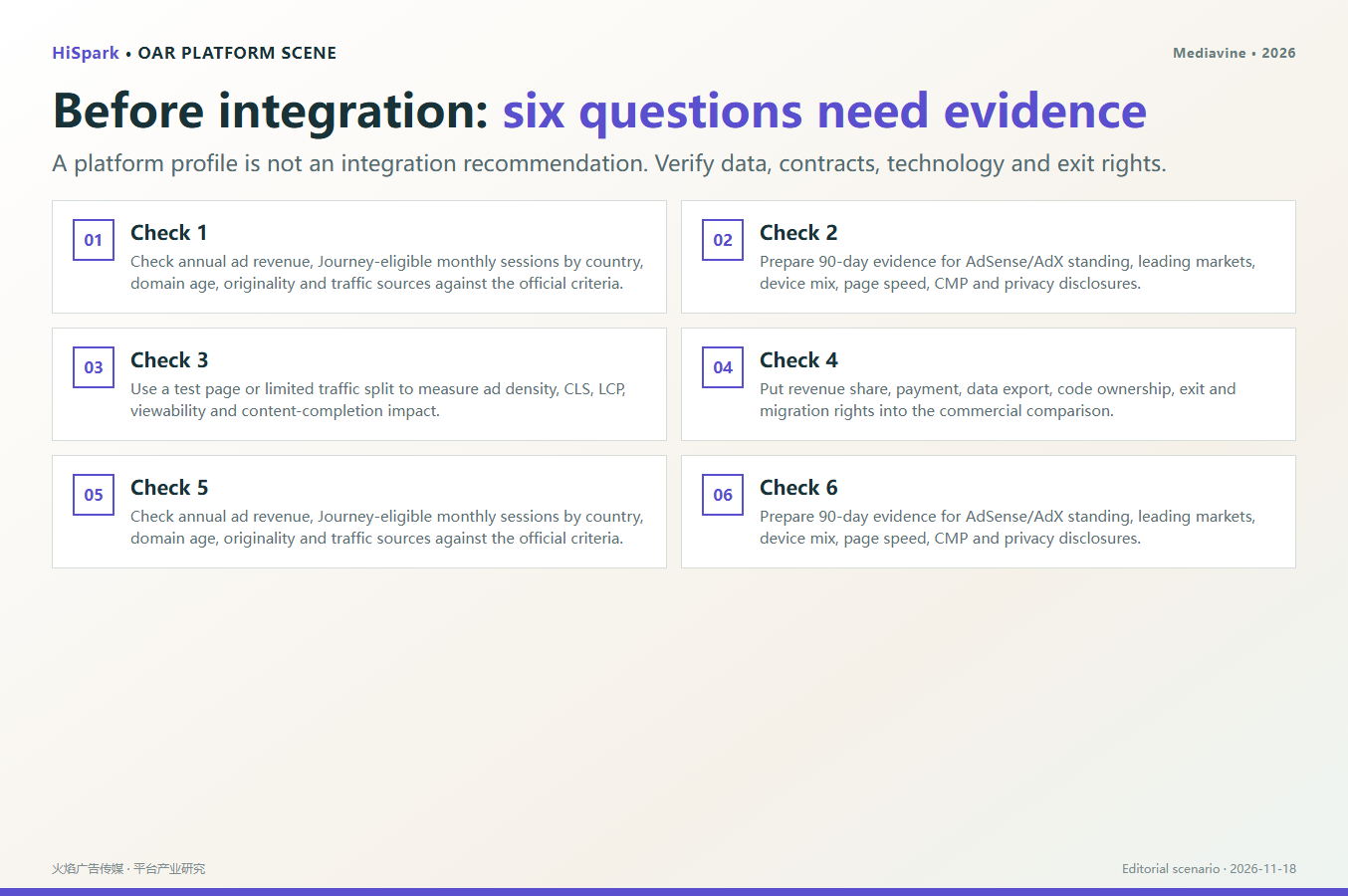
- Check annual ad revenue, Journey-eligible monthly sessions by country, domain age, originality and traffic sources against the official criteria.
- Prepare 90-day evidence for AdSense/AdX standing, leading markets, device mix, page speed, CMP and privacy disclosures.
- Use a test page or limited traffic split to measure ad density, CLS, LCP, viewability and content-completion impact.
- Put revenue share, payment, data export, code ownership, exit and migration rights into the commercial comparison.
- After launch, review monetised sessions, RPM, speed, engagement and organic search together instead of judging short-term revenue alone.
10. Five-minute fit scorecard
Use this as a decision aid, not a platform rating. Start from zero, add two points for each matching fit condition and deduct two for each pause signal.
| Score | Condition |
|---|---|
| ('+2', 'Already true') | A site has repeat search, direct or loyal-reader traffic and original editorial content in verticals such as food, travel, home, parenting, finance or technology. |
| ('+2', 'Already true') | The publisher already uses AdSense/AdX and is prepared for vetting, ad-experience standards and ongoing performance review. |
| ('+2', 'Already true') | A multi-brand publisher wants one operating layer for technology, demand and reporting. |
| ('-2', 'Deduct if true') | Traffic depends on short bursts, incentives, scraped content or unverifiable sources. |
| ('-2', 'Deduct if true') | The site is below the revenue or Journey traffic thresholds and treats platform access as a substitute for growth. |
| ('-2', 'Deduct if true') | The team will not address ad density, page speed, consent management or reader experience. |
8+ points: run a controlled pilot. 4–7: resolve missing evidence first. Below 4: wait or choose another platform role.
11. Four-stage validation plan
The goal is not to finish integration quickly. The goal is to produce evidence that can survive a commercial, technical and management review.
| Stage | Action |
|---|---|
| Week 1 | Check annual ad revenue, Journey-eligible monthly sessions by country, domain age, originality and traffic sources against the official criteria. |
| Week 2 | Prepare 90-day evidence for AdSense/AdX standing, leading markets, device mix, page speed, CMP and privacy disclosures. |
| Weeks 3-4 | Use a test page or limited traffic split to measure ad density, CLS, LCP, viewability and content-completion impact. |
| Post-test | Put revenue share, payment, data export, code ownership, exit and migration rights into the commercial comparison. |
Write the stop condition before the pilot starts. A platform test without a stop rule usually becomes an accidental permanent dependency.
12. Common failure modes
These are the situations that most often turn a platform introduction into wasted time or a migration problem.
Traffic depends on short bursts, incentives, scraped content or unverifiable sources.
The site is below the revenue or Journey traffic thresholds and treats platform access as a substitute for growth.
The team will not address ad density, page speed, consent management or reader experience.
13. Continue reading: adjacent platform roles
Compare adjacent roles instead of treating every platform as a substitute. The strongest stack usually combines complementary layers.
14. Frequently asked questions
What is the difference between Mediavine and Journey by Mediavine?
Full Mediavine requires at least USD 5,000 in annual ad revenue. Journey serves growing publishers below that threshold, with the official seven-market monthly session minimum and continued review of content, traffic and domain age.
Does meeting the traffic threshold guarantee approval?
No. The official criteria also cover original content, clean brand-safe traffic, AdSense/AdExchange standing and reader experience. Thresholds are necessary, not automatic approval.
Is Mediavine a replacement for AdSense?
Not a simple either-or. AdSense/AdX remain important demand and monetisation components; Mediavine operates higher in the stack through publisher vetting, multi-demand competition, placements, technology and managed operations.
Should the decision be based only on RPM?
No. Page speed, viewability, completion, organic search, consent and payment quality should be reviewed together or short-term revenue may hide damage to user experience.