
A content, information, utility or vertical publisher has repeat search and direct traffic.

Media.net
Sell-side platform & managed header bidding · Publisher-side revenue operations
1. Platform role and category
Media.net positions itself as a sell-side platform serving brands and publishers across display, native, video, managed Prebid and content recommendation.
The official site stresses exclusive performance budgets, AI-driven yield optimisation, a unified control panel and more than 15 years of open-web intent experience.
It supplies both demand and technology or services, so a single ad-network or SSP label is incomplete.
2. Business model and commercial terms
No uniform revenue share is published. Terms usually depend on site, demand mix, managed Prebid and formats; marketing pages do not establish one price for all publishers.
The Accelerate suite emphasises managed Prebid, machine learning, customisation, unified control and alerts, serving teams without full ad-ops capacity.
Vertical video, AI video summaries and content recommendation can create additional inventory and revenue, but raise content rights, generation, brand-safety and UX questions that need separate approval and controls.
3. Where value comes from
Value levers
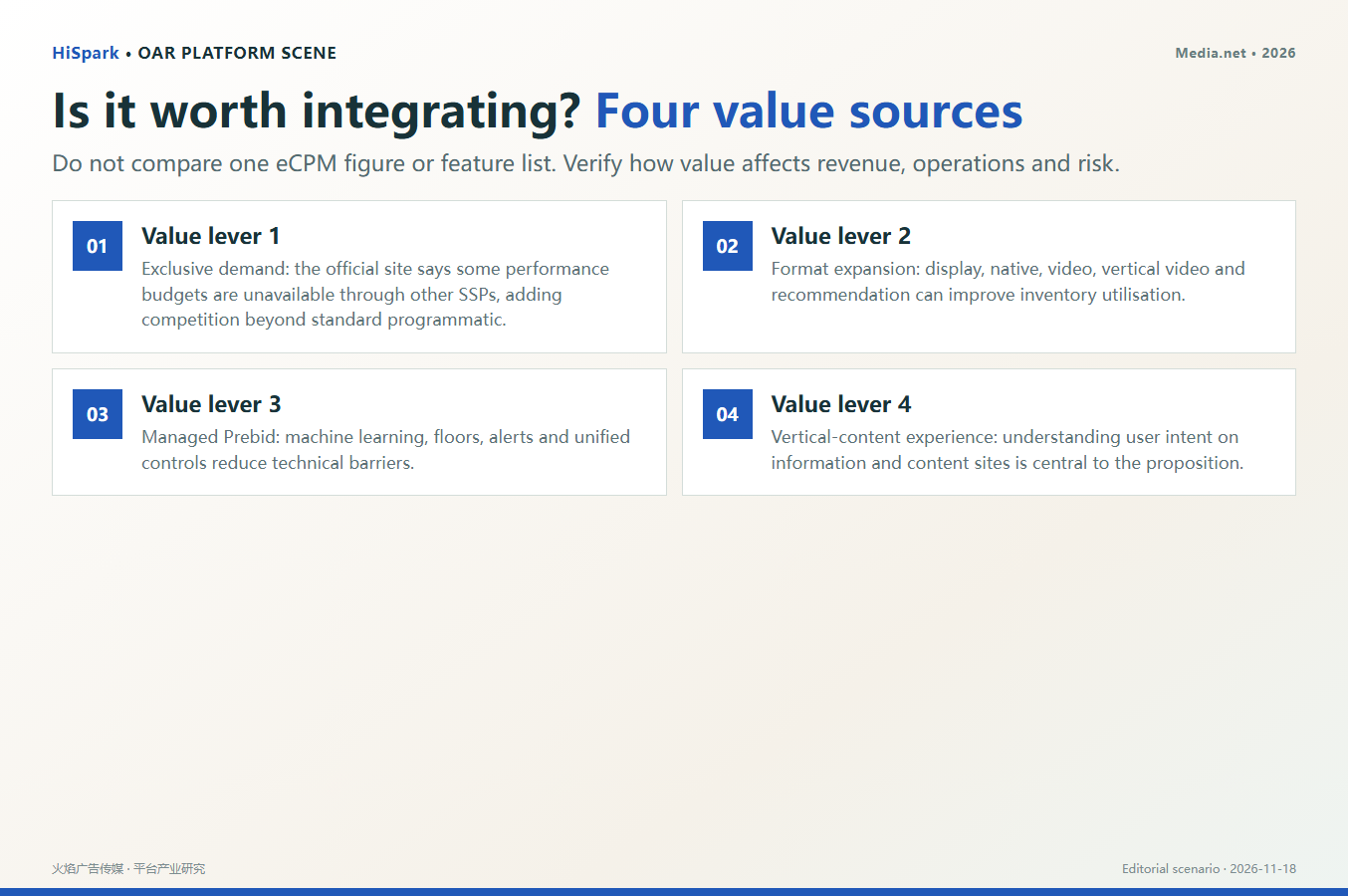
- Exclusive demand: the official site says some performance budgets are unavailable through other SSPs, adding competition beyond standard programmatic.
- Format expansion: display, native, video, vertical video and recommendation can improve inventory utilisation.
Operating value
- Managed Prebid: machine learning, floors, alerts and unified controls reduce technical barriers.
- Vertical-content experience: understanding user intent on information and content sites is central to the proposition.
4. Who fits, and who should wait
A good fit when
- A content, information, utility or vertical publisher has repeat search and direct traffic.
- The team wants exclusive performance demand, managed Prebid, native or video without building the full stack alone.
- Content rights, brand safety and UX have an owner who can review automated video and recommendation products.
Do not rush when
- Content is thin, unverifiable or driven by short-term traffic and does not support a contextual, brand-safe proposition.
- The publisher cannot review automated video, recommendation content and rights.
- The team requires a fully open self-service and standard published price.
- The publisher wants the highest short-term eCPM but cannot manage density or UX impact.
5. A controlled integration path
- Document content types, search traffic, markets, current RPM and formats as a baseline.
- Separate the contribution of exclusive demand, standard programmatic, managed Prebid and video or content products.
- Test AI video summaries, vertical video and recommendation modules against speed, duration and bounce on control pages.
- Confirm content rights, responsibility for generated assets, brand safety and takedown workflow.
- Define revenue share, payment, data use, ad code, IP and removal of content/video assets after exit.
6. AdSense, SSP and publisher optimisation are different roles
| Role | Category | What it primarily sells |
|---|---|---|
| Media.net | Sell-side platform & managed header bidding | Exclusive demand, managed Prebid, display/native/video |
| Mediavine | Publisher network & managed monetisation | Curated publisher network and premium demand |
| PubMatic | Sell-side platform | Inventory monetisation, transactions and demand |
| Ezoic | Publisher monetisation optimisation | Automated testing, mediation and growth tools |
A publisher can use multiple layers together. The decision is not which logo replaces another, but who controls demand, inventory, testing, data, compliance and operations.
7. Typical customer scenarios
Put the platform back into a real publisher or advertiser workflow. The same feature set can be valuable for one team and premature for another.
The team wants exclusive performance demand, managed Prebid, native or video without building the full stack alone.
Content rights, brand safety and UX have an owner who can review automated video and recommendation products.
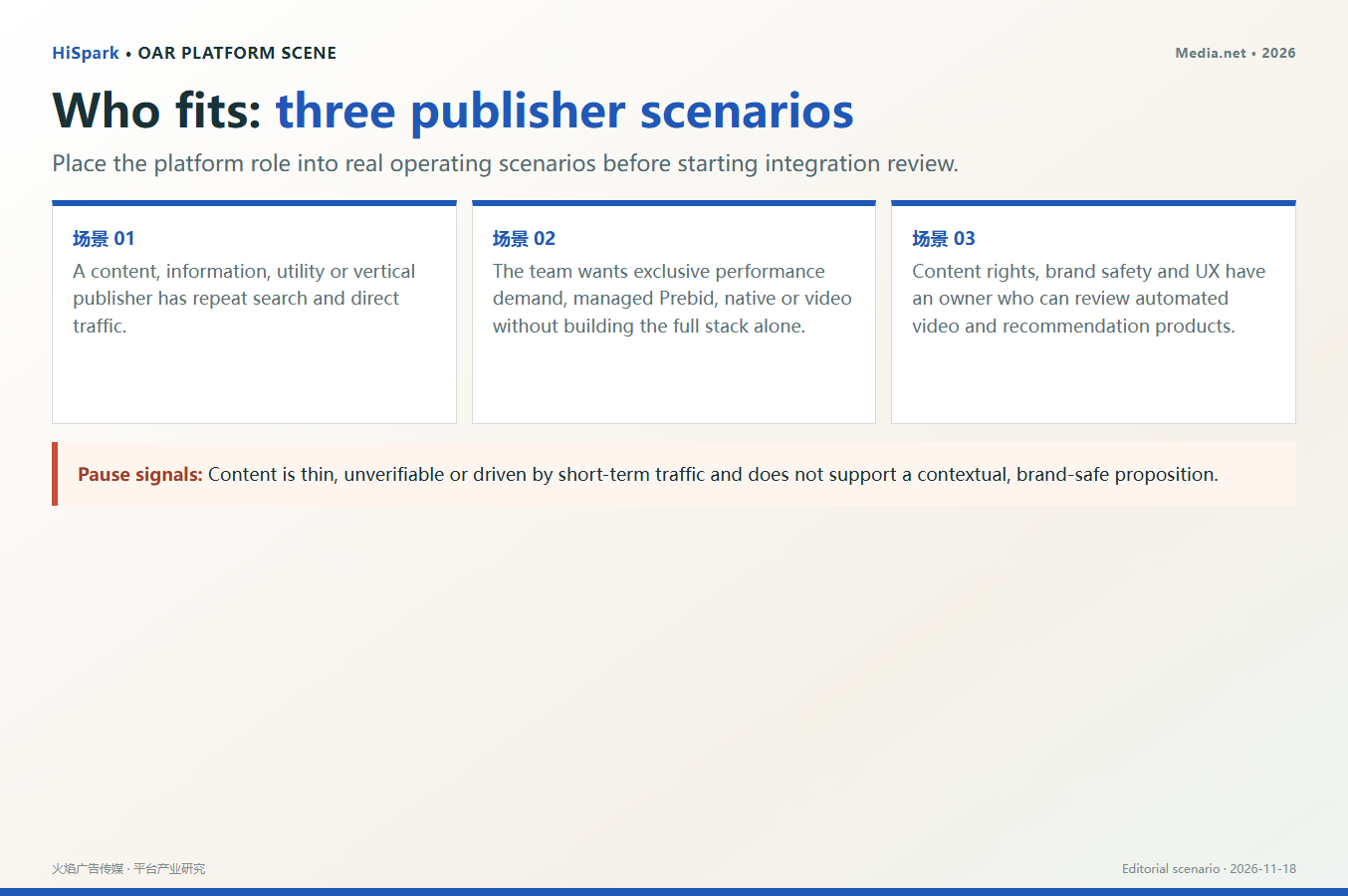
Pause signals
- Content is thin, unverifiable or driven by short-term traffic and does not support a contextual, brand-safe proposition.
- The publisher cannot review automated video, recommendation content and rights.
- The team requires a fully open self-service and standard published price.
- The publisher wants the highest short-term eCPM but cannot manage density or UX impact.
8. How to judge whether the value is real
Do not reduce the decision to one headline metric. Value must be visible in revenue quality, operating hours, risk control and the ability to explain results to management.
| Value source | What to verify | Evidence |
|---|---|---|
| Exclusive demand: the official site says some performance budgets are unavailable through other SSPs, adding competition beyond standard programmatic. | Validate with live data, not a feature list. | Dashboard, contract, test page or implementation record. |
| Format expansion: display, native, video, vertical video and recommendation can improve inventory utilisation. | Validate with live data, not a feature list. | Dashboard, contract, test page or implementation record. |
| Managed Prebid: machine learning, floors, alerts and unified controls reduce technical barriers. | Validate with live data, not a feature list. | Dashboard, contract, test page or implementation record. |
| Vertical-content experience: understanding user intent on information and content sites is central to the proposition. | Validate with live data, not a feature list. | Dashboard, contract, test page or implementation record. |
Official product, documentation and case evidence
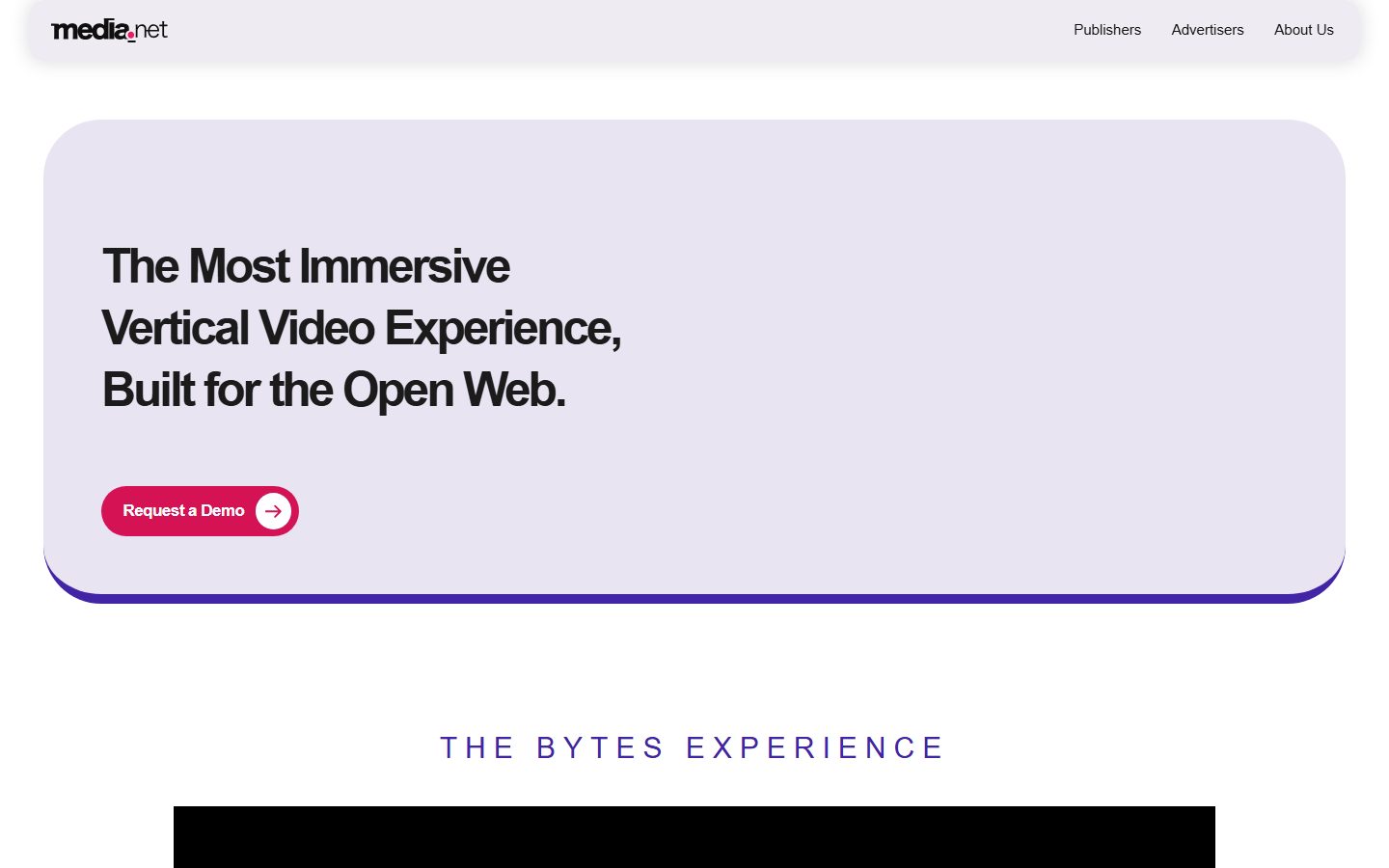
These screenshots come from official product, documentation, eligibility or case-study pages captured on 18 Nov 2026. They are included as visual evidence for the platform’s current public proposition, not as a guarantee of commercial terms.

9. Pre-integration evidence checklist
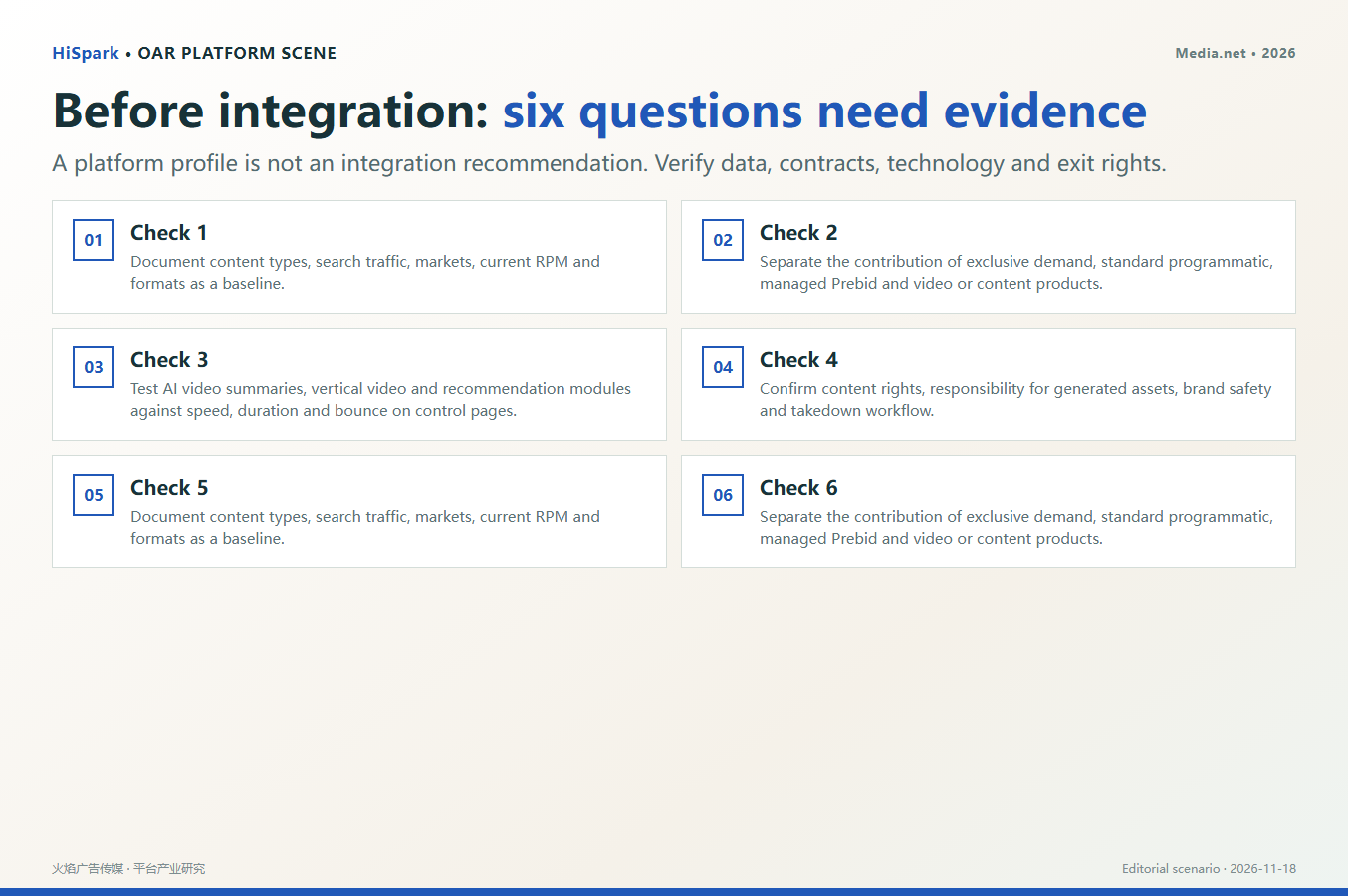
A platform introduction is not an integration recommendation. The following items should have an owner, a current artefact and a decision date.
- Document content types, search traffic, markets, current RPM and formats as a baseline.
- Separate the contribution of exclusive demand, standard programmatic, managed Prebid and video or content products.
- Test AI video summaries, vertical video and recommendation modules against speed, duration and bounce on control pages.
- Confirm content rights, responsibility for generated assets, brand safety and takedown workflow.
- Define revenue share, payment, data use, ad code, IP and removal of content/video assets after exit.
10. Five-minute fit scorecard
Use this as a decision aid, not a platform rating. Start from zero, add two points for each matching fit condition and deduct two for each pause signal.
| Score | Condition |
|---|---|
| ('+2', 'Already true') | A content, information, utility or vertical publisher has repeat search and direct traffic. |
| ('+2', 'Already true') | The team wants exclusive performance demand, managed Prebid, native or video without building the full stack alone. |
| ('+2', 'Already true') | Content rights, brand safety and UX have an owner who can review automated video and recommendation products. |
| ('-2', 'Deduct if true') | Content is thin, unverifiable or driven by short-term traffic and does not support a contextual, brand-safe proposition. |
| ('-2', 'Deduct if true') | The publisher cannot review automated video, recommendation content and rights. |
| ('-2', 'Deduct if true') | The team requires a fully open self-service and standard published price. |
8+ points: run a controlled pilot. 4–7: resolve missing evidence first. Below 4: wait or choose another platform role.
11. Four-stage validation plan
The goal is not to finish integration quickly. The goal is to produce evidence that can survive a commercial, technical and management review.
| Stage | Action |
|---|---|
| Week 1 | Document content types, search traffic, markets, current RPM and formats as a baseline. |
| Week 2 | Separate the contribution of exclusive demand, standard programmatic, managed Prebid and video or content products. |
| Weeks 3-4 | Test AI video summaries, vertical video and recommendation modules against speed, duration and bounce on control pages. |
| Post-test | Confirm content rights, responsibility for generated assets, brand safety and takedown workflow. |
Write the stop condition before the pilot starts. A platform test without a stop rule usually becomes an accidental permanent dependency.
12. Common failure modes
These are the situations that most often turn a platform introduction into wasted time or a migration problem.
Content is thin, unverifiable or driven by short-term traffic and does not support a contextual, brand-safe proposition.
The publisher cannot review automated video, recommendation content and rights.
The team requires a fully open self-service and standard published price.
13. Continue reading: adjacent platform roles
Compare adjacent roles instead of treating every platform as a substitute. The strongest stack usually combines complementary layers.
14. Frequently asked questions
Is Media.net an ad network or an SSP?
It covers both roles. It provides sell-side infrastructure and demand plus managed Prebid and formats, so the actual scope must be separated in the agreement.
Does exclusive demand always bid higher than other SSPs?
No guarantee. Exclusive budgets, standard programmatic, floors and fill should be tested in one controlled comparison.
Are AI video summaries and vertical video suitable for every site?
No. They change content and advertising experience and require rights, brand-safety and user testing.
What should a publisher ask before integrating?
Revenue share, demand sources, data rights, managed scope, rights for video and recommendation products, reconciliation and exit migration.