


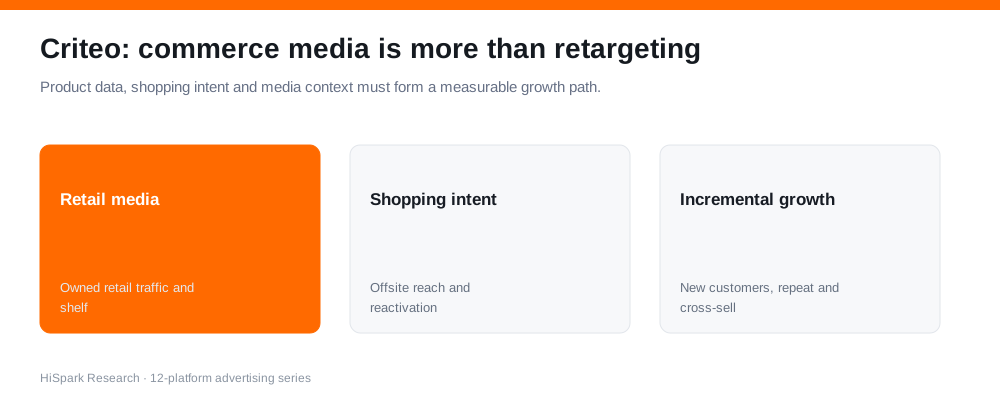
Criteo is often described as a retargeting vendor, but that only captures its earliest product form. Its more accurate role today is a commerce media platform connecting brands, retailers, product feeds and media inventory.
The value is not one ad placement. It is whether product data, audience signals, onsite retail environments and offsite media can form a measurable growth system. Results vary sharply by basket size, repeat frequency and catalogue depth.
1. Where Criteo sits in the ad chain
Traditional display media starts with audience segments. Criteo starts closer to products and shopping behaviour, linking product catalogues, user-product interactions, retail media inventory and offsite placements.
It is therefore neither a pure DSP nor a classic ad network. Criteo sits between retail media and performance advertising: catalogue quality on one side, media scale and optimisation on the other.
2. Data, products and context
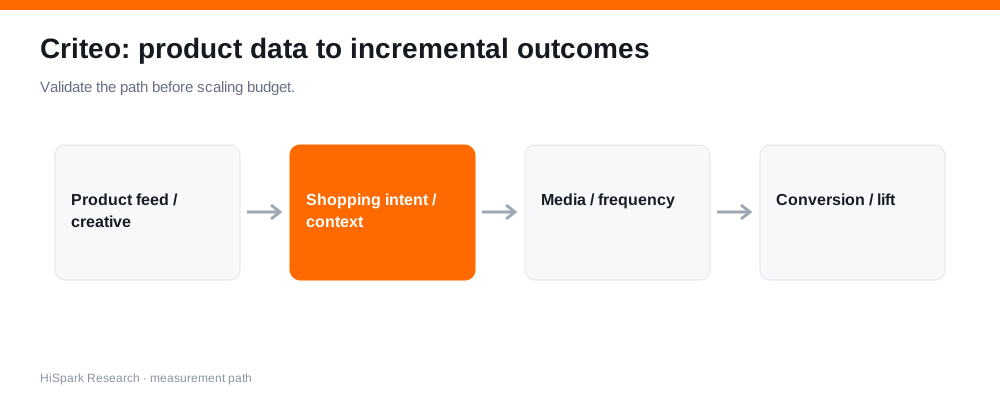
The first layer is product data: SKU, price, availability, creative assets and taxonomy determine whether the ad can describe the offer accurately. The second is intent: browsing, search, add-to-cart, purchase cadence and cross-category interest. The third is media context.
Remove one layer and performance becomes distorted. A weak catalogue turns the system into broad audience buying; without retail signals, intent decays; without frequency control and measurement, reports may reward clicks rather than incremental sales.
3. Which businesses fit
Criteo is most useful for businesses with broad catalogues, comparable purchase decisions and meaningful repeat or cross-sell potential: fashion, beauty, consumer electronics, home, baby and selected FMCG categories.
Where the product feed is unstable, landing pages are weak or conversion data cannot be returned, fixing the foundation matters more than adding another platform. Criteo is not an automatic order machine; it is a system that depends on product and data operations.

4. Measuring true incrementality
Retargeting is where Criteo can look most obviously effective. The harder question is how many of those orders would have happened anyway. If budget only rewards recent site visitors, reports can look strong while incrementality stays limited.
A better framework compares new-customer acquisition, reactivation, category expansion and onsite/offsite media inside one test design. Track incremental orders, contribution margin, acquisition cost, retention and frequency rather than ROAS alone.
5. Put it back into the value chain: five roles are not interchangeable
Criteo belongs to Retail & Commerce Media. A common mistake is to judge it with metrics owned by another role: demanding DSP-style ROAS from an SSP, or judging an ad server by network fill, produces distorted conclusions.
The better question is which core resource it controls, and whether that resource converts into a verifiable business outcome. For Commerce media and shopping intent, scale is not the only answer; transaction quality, data availability and governance matter equally.
Establish the business type and readiness conditions before discussing integration or optimisation. Applying one KPI across every role often turns an organisational issue into a false platform issue.
| Industry role | Core resource controlled | Question to validate |
|---|---|---|
| DSP / demand platform | Budget, audiences and optimisation goals | Can it buy the right audience at a controllable cost? |
| Commerce media THIS PLATFORM | Product data, shopping intent and retail/offsite context | Do product, data and media create incrementality? |
| Native / discovery network | Publisher context, content consumption and next-click attention | Can content turn clicks into valuable actions? |
| SSP / sell-side platform | Inventory, auction paths, signals and deal rules | Can it improve net yield while protecting experience? |
| Omnichannel ad platform | Identity, content context, DSP and multi-screen supply | Can it unify identity, frequency, creative and measurement? |
Quick fit check: who is ready and who should build foundations first
| Business type | Best-fit context | Readiness required | Avoid when |
|---|---|---|---|
| Established ecommerce | Stable catalogue, clean conversion data and offsite growth goals | Product feed, events and audience permissions | Treating it only as a cheap retargeting line |
| Retail media partner | Owns onsite traffic and commerce data | Inventory integration, ad governance and brand sales | Opening inventory without supply operations |
| Early-stage brand | Run a controlled pilot to validate fit | Comparable landing pages, budget and incrementality rules | Using one platform as a substitute for product validation |
Platform reference: Criteo