 Shenzhen HiSpark Ad Media Co., Ltd.
One-line conclusion: Amazon Ads does not sell traffic, it sells purchase intent. Users are not being interrupted while reading something; they are already planning to buy.
That one difference drives three characteristics: the ad units sit next to search results rather than on content pages, attribution can run all the way to a completed sale, and in the new category of retail media it has long been the player writing the definition.
This piece breaks Amazon Ads down across nine dimensions: company basics, business model, product matrix, data and attribution, the Prime Video variable, competition, the risk surface, what it means for teams doing overseas marketing, and a short summary.




1. Company basics: from on-site placements to the world's No. 3 ad platform
| Stage | Timing | What happened |
|---|---|---|
| Start | Around 2010 | Productised on-site product placements, serving marketplace sellers first |
| Scale-up | 2015 to 2020 | The ad line expanded from search into display and video |
| Category definition | After 2020 | Retail media became a standalone category, with Amazon as its definer |
| Beyond the store | 2022 to 2026 | Streaming TV, live sports and connected-TV inventory opened up |
Four stages of Amazon Ads
The takeaway: this did not start as a media business. It started as a shelf. The ad units grew on the shopping path rather than on content pages, and that origin shapes every product decision since.
2. Business model: advertisers pay a premium for the slot closest to the checkout
| Player | Who they are | Why they pay |
|---|---|---|
| Brands | Consumer brands | To appear in the last mile of the purchase decision |
| Marketplace sellers | Third-party sellers on Amazon | To fight for visibility on the first page of search results |
| Agencies and tool vendors | Media service providers | To manage and optimise campaigns for clients |
Why advertisers pay more here
Core judgment: the pricing basis here is certainty of conversion, not the scale of traffic.
The same impression means different things on different platforms. On a content platform, an impression proves somebody saw something. On Amazon, an impression can be tied to what that person went on to buy. That verifiability is why advertisers will pay more for the identical impression, and it is the root reason this business went from nothing to the world's third-largest ad platform.
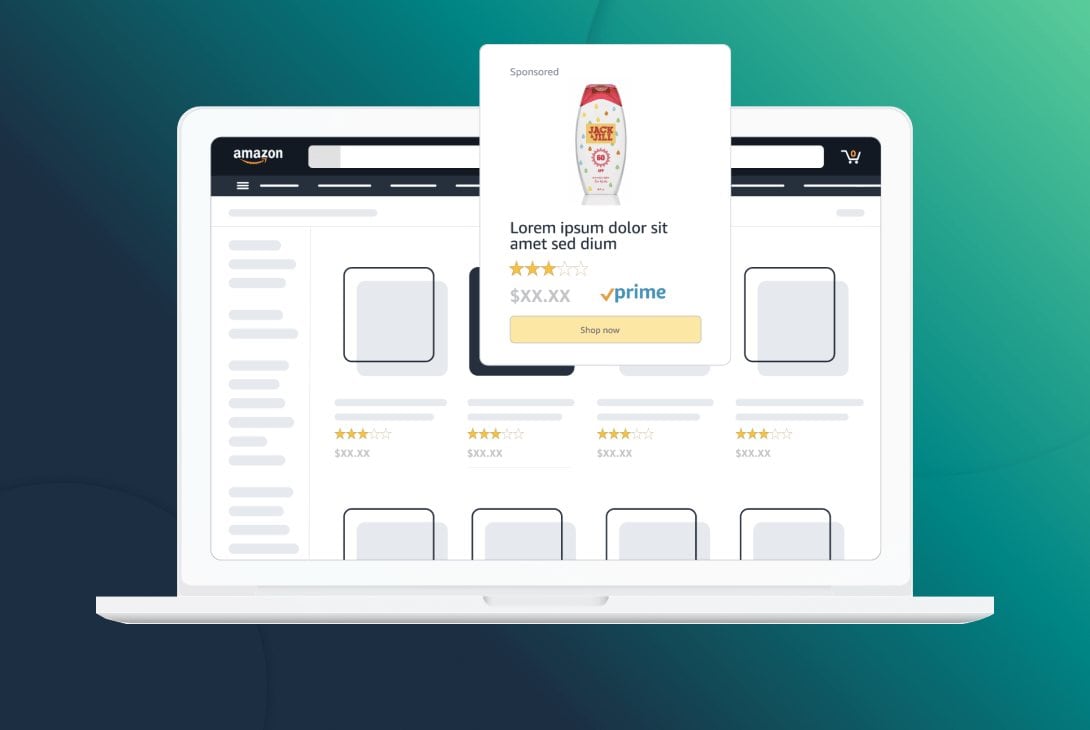
3. Product matrix: four layers, from search to streaming
| Layer | Product form | Main job |
|---|---|---|
| Search | Sponsored Products, Sponsored Brands | Intercept traffic that already has clear purchase intent |
| Display | Display ads, off-site buying | Extend reach beyond Amazon itself |
| Video and TV | Streaming TV, live sports | Extend from performance into brand advertising |
| Data | Marketing Cloud and measurement tools | Cross-channel attribution and audience insight |
Four layers, from search to streaming
The direction of travel is clear: sell the slot closest to the checkout first (search), then add brand budget on top (video and TV), then lock advertisers into the loop with data tools.
The most recent product cycle has been about AI. At its unBoxed event in San Francisco, Amazon Ads announced new AI-powered advertising solutions, creative tools and measurement capabilities, including AI image generation for ad creative. The point of that line is to push from aiming well to producing fast: creative production was historically the slowest and most expensive step in the buying chain.

4. Data and attribution: the real moat sits in this layer
| Dimension | Ads on content platforms | Amazon Ads |
|---|---|---|
| Intent signal | Inferred interest | Actual purchase and search behaviour |
| Attribution path | Impression to click | Impression to completed sale |
| Data ownership | The platform's own | First-party shopping data |
| Measurement tools | Mostly third party | In-house tools and data clean rooms |
The moat sits in the data layer
This is the hardest part to copy. Any ad platform can buy traffic. None of them can buy the knowledge of what a user actually bought, because that belongs to the transaction platform itself. It is the fundamental reason retail media could become its own category.

5. The Prime Video variable: from performance into brand budgets
Putting advertising into a mainstream streaming service was a move of a different order of magnitude.
It matters on three levels. First, ad inventory jumps in scale, from limited on-site placements to streaming hours worldwide. Second, the budget type changes, crossing from performance budgets into brand budgets, and the brand pool is far larger. Third, audience data joins up, layering shopping audiences on top of viewing audiences.
The cost is the balance with user experience. When paying members originally subscribed partly to avoid ads, and advertising becomes the default, drawing the line between revenue and experience becomes a long-running question.

6. Competition: retail media is getting crowded
| Rival type | Form | How they compete |
|---|---|---|
| Other retail platforms | Retailers and marketplaces building ad businesses | Using the same first-party transaction data to chase brand budgets |
| Traditional ad giants | Search and social platforms | Holding share through traffic scale and ecosystem lock-in |
| Independent ad networks | Third-party buying platforms | Winning smaller advertisers with more flexible pricing |
The real pressure comes from the first group. Once every retail platform can offer first-party purchase data plus closed-loop attribution, Amazon's head start flattens out, and the competition returns to who offers better tools and sharper audiences.
7. Risk: three long-term constraints
One, the tension between ads and experience. Ad density on search results is a recurring debate, and both regulators and consumers will constrain it.
Two, the complexity of the numbers. Ad revenue is entangled with the retail business, making it hard for outsiders to assess the true scale and margin from any single lens.
Three, growth depends on the platform's own transaction volume. Advertising is a function of transactions. If the marketplace slows, ad growth eventually follows.
8. What it means for us: three judgments for overseas marketing
| Question | How to ask it | Amazon Ads' answer |
|---|---|---|
| Nature of the traffic | Intent-driven or not? | Intent-driven. Pricing rests on conversion certainty |
| Who owns the data | Who holds it? | First-party transaction data, the hardest to copy |
| Budget type | Performance or brand? | Both, achieved by expanding beyond the store |
| Growth ceiling | What sets it? | The platform's transaction volume |
| Risk | The biggest constraint? | Balancing ad density against experience |
The most important row: in marketing, how close traffic is to a completed transaction decides what it is worth. The first question for anyone buying media is not how cheap the traffic is, but how far it sits from the sale.
9. Summary
- Identity: Amazon Ads is a retail media platform. It sells purchase intent, not impressions.
- Structure: search holds the conversion layer, video and TV widen the brand budget.
- Moat: first-party shopping data and closed-loop attribution, the hardest to replicate.
- Constraint: growth depends on platform transaction volume, and ad density is bounded by experience and regulation.
A fit table across search, display and video, plus baseline checks for first-party data and closed-loop attribution.
What is inside:
- A fit table across the three product layers: search, display and video
- Baseline checks for first-party data and closed-loop attribution
- A self-check list for the buying and monetization architecture of an overseas e-commerce business